House To Let

100_4814She comported herself with an imperiousness appropriate to the well connected memsahib she that was in her early married life half century before.

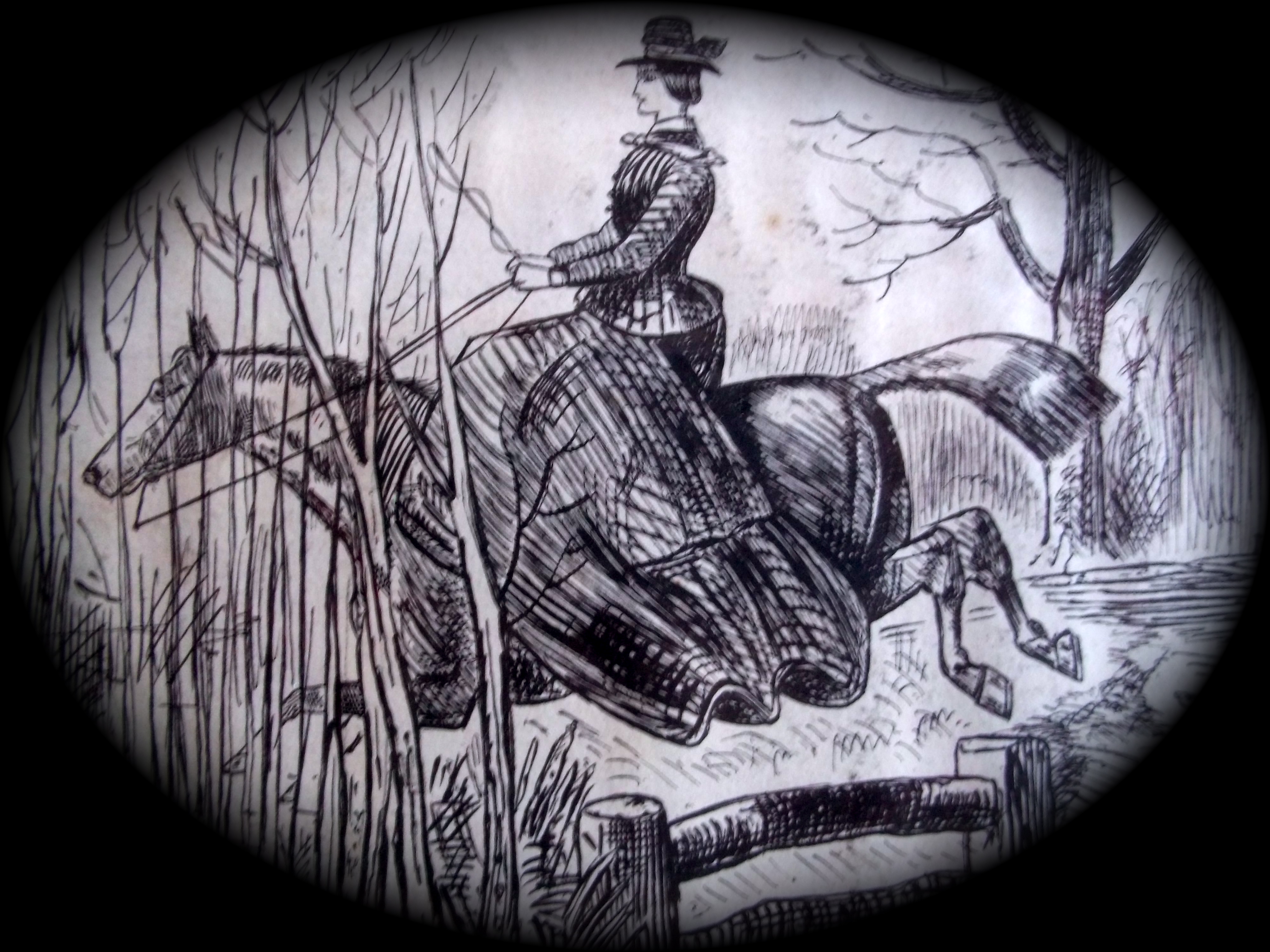
In her black riding habit and veiled top hat, Mrs. Geraldine Thomas, the last private tenant of Orgreave Hall, was often seen, well into the ninth decade of her life, determinedly venturing forth, riding side-saddle, between the shady lime tree avenues and across the level, green parkland surrounding her home. Captain Thomas had died 20 years previously, leaving her alone in the mansion, apart from the encroaching presence of sub-tenants in the periphery of the estate.

100_4819In the new, egalitarian Britain of the 1960’s, Mrs Thomas was uneasily aware that she was a living anachronism. She declined to exchange money for the horse fodder supplied to her by her farmer neighbours, and in exercising this small droit de seigneur she was making a small gesture of remembrance towards the world into which she was born, in which the duties of her tribe, to be warriors, pioneers, and leaders of men, were supported by small armies of household servants.

According to Lucy Lethbridge’s recent book “Servants: A downstairs view of 20th century Britain,” Lord Curzon, only a generation senior to Mrs Thomas, entirely accustomed as he was to having his every need accommodated by his staff, was once so baffled by the problem of how to open a window without a servant at hand that he ended up smashing it with a log. Civilised life might break down altogether without the capable hand of the paid domestic assistant.

One of the long abiding inhabitants of Orgreave remembers himself scuffing through a six inch deep layer of leaves on the floors of the fine seventeenth century house towards an audience with Mrs Thomas in the drawing room in Orgreave Hall. Whether she allowed this foliacious carpeting to accrue through her lack of facility with a broom, or out of resignation to changing times, we do not know.

In common with Lord Curzon, Mrs Thomas had strong connections with the British Imperial presence in the Indian Subcontinent. She had married in 1907, Captain Edward Hector Le Marchant Thomas, whose family’s interests in the Galleheria Coffee plantation in Ceylon, where he was born in 1867, provided them with a healthy income. His maternal grandfather, Tom Skinner, had been responsible for the construction of the Columbo – Kandy highway early in the 19th century, and had explored, and mapped, previously uncharted areas of the island. Geraldine’s own father, Colonel George Pilkington Blake, had served in the Suffolk Imperial Yeomanry during the Indian Mutiny of 1856-7. Her elder sister Adeline married Hardinge Hay Cameron, of interest not just because of his family’s own involvement in India and Ceylon, but because his mother was the famous pioneering Victorian photographer, Julia Margaret Cameron. In widowhood, Adeline came to live with her sister and brother in law at Orgreave.

100_4824

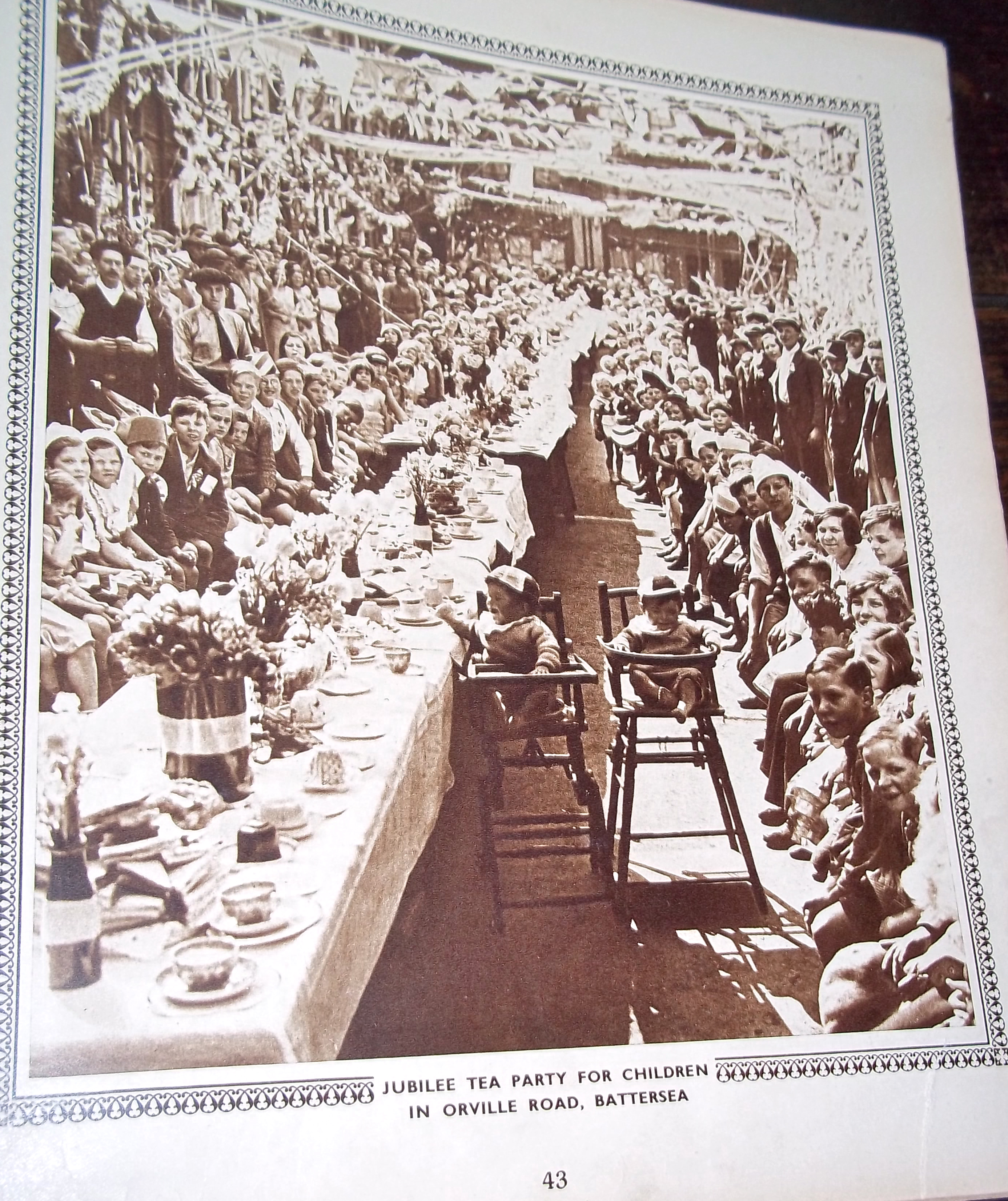
London children celebrate the Silver Jubilee of 1935.
From a book in my own collection.

The Lichfield Mercury of Friday 17th May 1935 pictures them in happy times, and performing roles in which I imagine them to be comfortable, leading local celebrations of the Silver Jubilee of King George and Queen Mary. Captain Thomas opened the event, hoisting the Union Jack after a few “well chosen words.” Mrs Cameron, (Adeline), presented prize money to the children who were victorious in their sports contests, and Mrs Thomas presented Jubilee cups and saucers. Each lucky child “also received oranges and sweets.”

When Adeline died in 1947,  “Burton Woman Leaves £3,009” screamed the Derby Daily Telegraph. It must have seemed a useful sum.

00051u

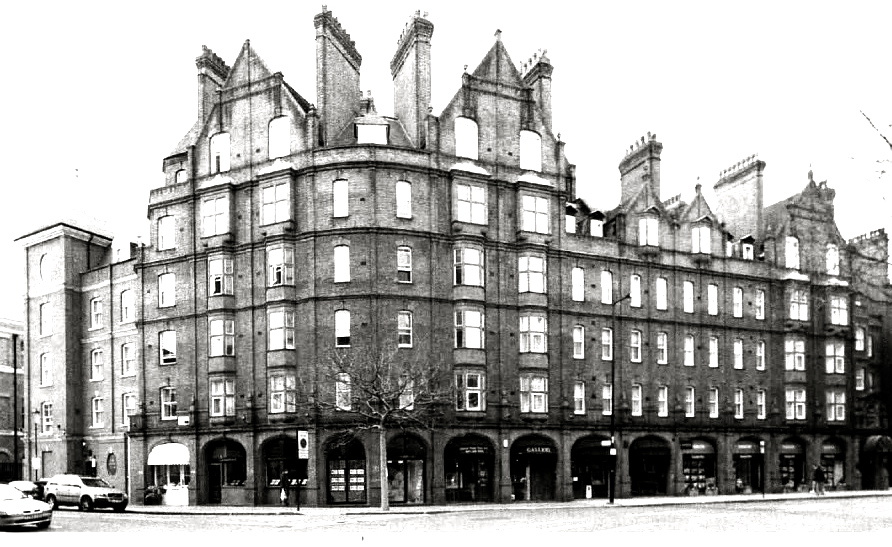
“Sloane Gardens House”
from “Where shall she live?”: Housing the New Working Woman in Late Victorian and Edwardian London’, in Living, Leisure and Law: Eight Building Types in England 1800-1941, ed. Geoff Brandwood.

Rising 40 and 31 years old respectively when they married, both Edward and Geraldine had already lived remarkable lives. The 1901 census finds Geraldine living in an upmarket ladies’ hostel in London. “Sloane Gardens House” was built on behalf of the Ladies’ Associated Dwellings Company and had been opened in 1888 at 52, Lower Sloane Street.  Its purpose was the accommodation of ladies who might, whilst retaining their good name, choose to pursue a career – an idea still only newly acceptable to many.  These salubrious surroundings with their library, music room, and dining room were effectively  Geraldine’s student digs.  Far from working in commerce, Geraldine was studying fine art, particularly sculpture.

A palace of delights for Christmas 1901 were illuminated in the windows of the nearby Peter Jones department store, and her Michaelmas term drew to an end.  Meanwhile, her future husband’s Boer War medal, with a creditable five clasps, denoting his service among the Ceylon Mounted Rifles in the battles of  Dreifontein, Johannesburg, Diamond Hill, Wittebergen, and Cape Colony, was being collected by his brother Jocelyn, also a decorated veteran of the conflict. Edward had been invalided to England the previous year.  A third brother, Arthur, had perished, one of over 22,000 British casualties.  The Thomas brothers, not youths but men in their 30s, had travelled from one distant corner of The Empire to another for the sake of duty and adventure, and their father did not forget that one of them never returned home.

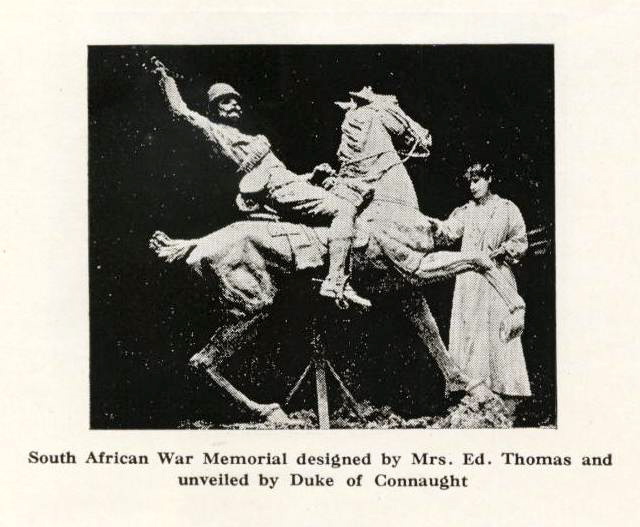
How did “Ted” Thomas become acquainted with Miss Geraldine Blake?  Perhaps a clue lies in the following.  A fine statue, representing a trooper of the Ceylon Mounted Infantry giving the signal “enemy is in sight” was commissioned by Mr Thomas senior in memory of his son and his fallen comrades. It was unveiled in Ceylon by H.R.H. The Duke of Connaught on March 18th 1907, some six weeks after the marriage of Lieutenant Thomas to the designer of the memorial.

cmi statue Cropped-3

Geraldine Blake Thomas with the statue she designed.
Image and information courtesy of Dr Jean Ferran.

Posted in Uncategorized | 4 Comments

The McGonagall of Gaia Lane

100_4806

There were several months of speculation before a new Poet Laureate was appointed in 1972, following the death of the incumbent, Cecil Day-Lewis.  With unemployment reaching a record one million, and the S.A.L.T. agreement finally being signed by the Russian and US presidents, I imagine that the Prime Minister, Edward Heath, thought he had more to worry about that summer than whose name he would be submitting to the Queen as Day-Lewis’s successor.

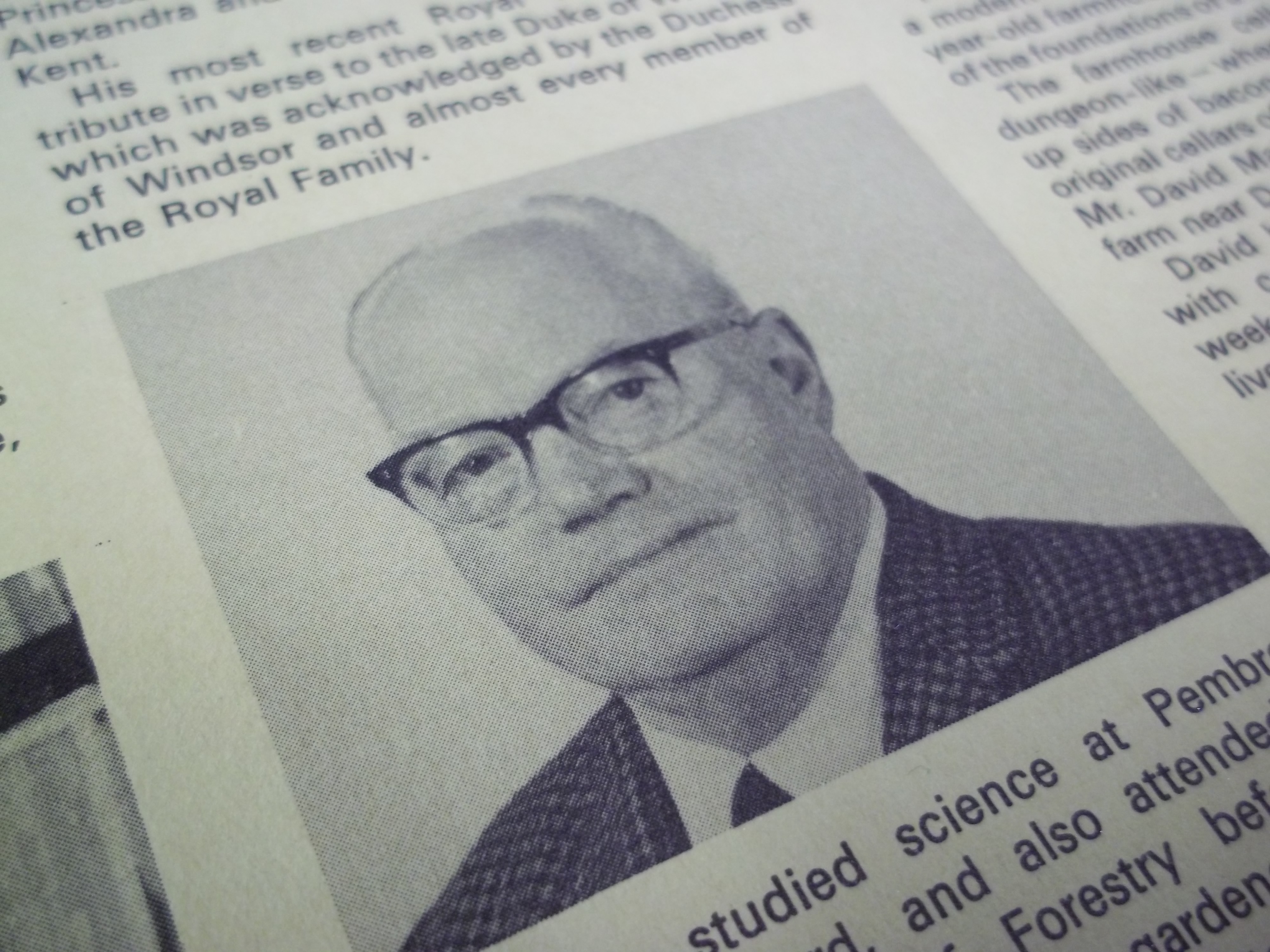
A short piece about Albert Sperrin, "Royal" Poet, appeared in the Lichfield and Tamworth Magazine in September 1972.

A short piece about Albert Sperrin, “Royal” Poet, appeared in the Lichfield and Tamworth Magazine in September 1972.

According to the Lichfield and Tamworth Magazine, at his home at 95, Gaia Lane, Lichfield, a hopeful candidate for the newly vacant position was relying on the advocacy of no less a figure than Earl Mountbatten of Burma to promote his cause. The eventful life of the minor Royal, Admiral of the Fleet and last Viceroy of India had recently inspired a lengthy verse narrative to be penned in this neat, turn-of-the-century, semi-detached cottage near Stowe Pool by productive wordsmith Albert Edward Sperrin, who lived there with his wife, Jessie.

Self styled “Poet for Royal Occassions,” Albert Sperrin, had received over 50 letters of acknowledgement from the Queen Mother, Duke of Edinburgh, Prince Charles and Princess Margaret, among others, according to the September 1972 edition of the local magazine. Even the black sheep of the Royal Family, the Duke of Windsor, had been the subject of one of Sperrin’s poetic tributes following his demise that May, for which his widow, the former Mrs. Wallis Simpson, was said to be grateful. Public events of all kinds had been marked by Mr Sperrin’s enthusiastic lyrical endeavours since the 1930s. Meanwhile, he had kept body and soul together by virtue of his day-job as Superintendent of Hospital Gardens, first in his native county of Oxfordshire, later in Birmingham and also his adopted city of Lichfield. He was proud to relate that like Doctor Samuel Johnson, Lichfield’s other famous man of letters, the young Albert had attended Pembroke College, Oxford. In parallel with Johnson, he, too, had been obliged to leave without attaining a degree because of a shortfall in the family finances.

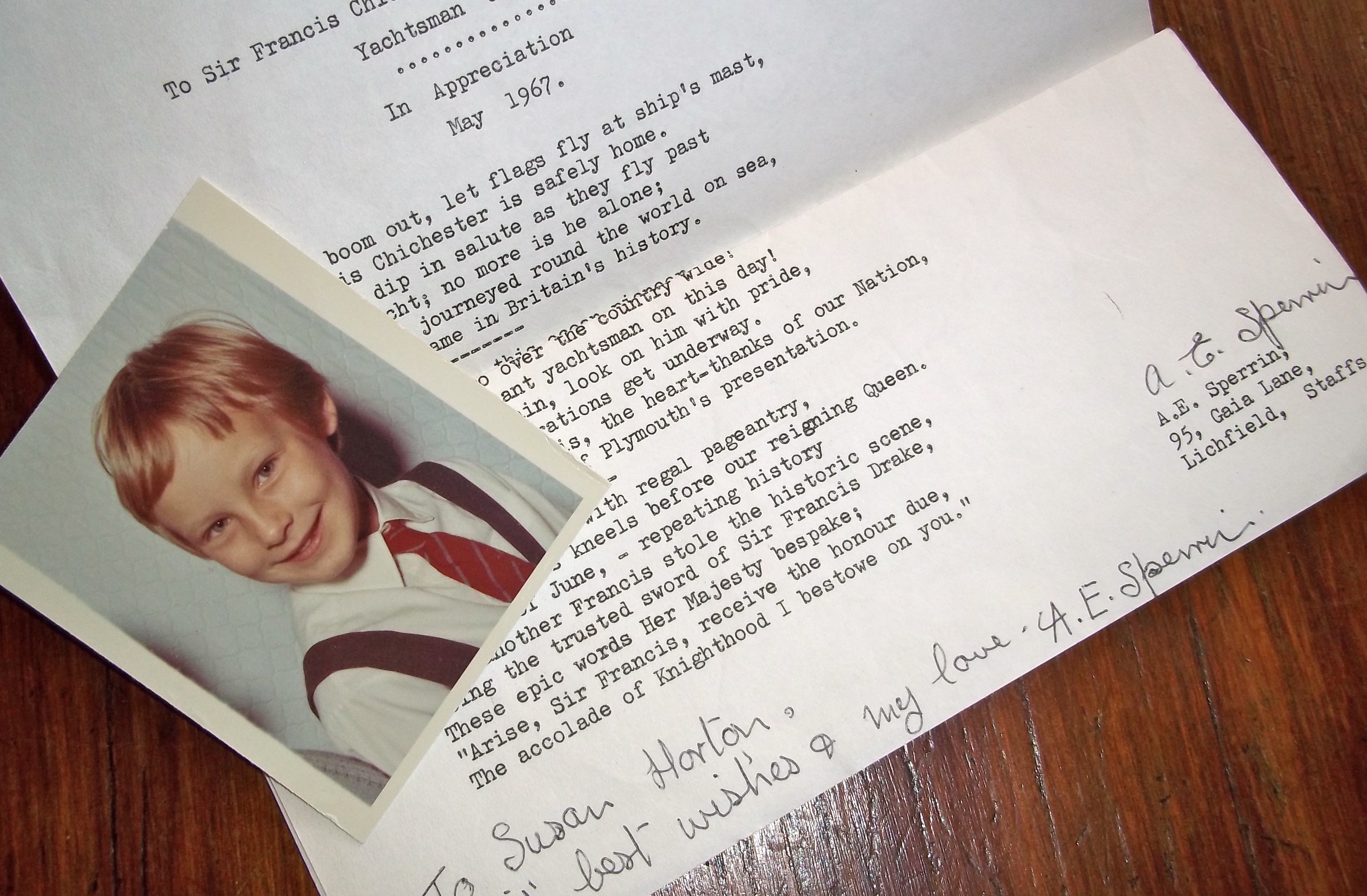
My dad had an eclectic portfolio of customers for his domestic building skills in and around Lichfield, and Mr. Sperrin looks likely to have been one of them. Why else do I have in my possession a copy of his snappily titled opus ” To Sir Francis Chichester, Britain’s lone around the World Yachtsman and Flier. In Appreciation May 1967″, annotated with a warm and personal dedication to me by the poet? Ted Horton formed easy, chatty, friendships with most of the people he worked for, and during tea-break conversations in his brown bib and braces, checked shirt, and narrow, woollen tie, there were inevitable references to me. Me, his daughter and only child, who at the age of six, already showed tedious signs of being “wordy”, and so would have genuinely appreciated the personalised draft of “To Sir Francis Chichester…et cetera.”

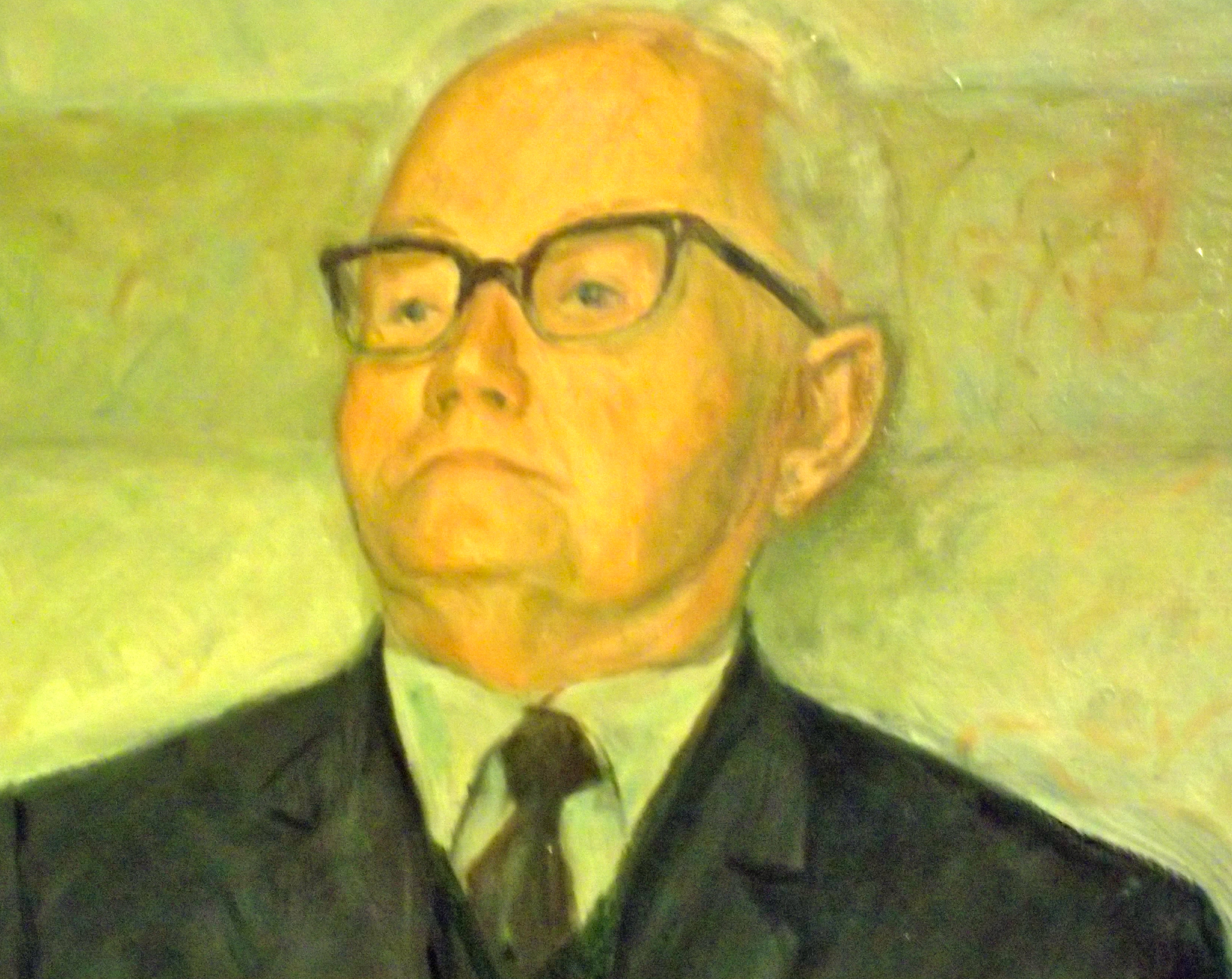
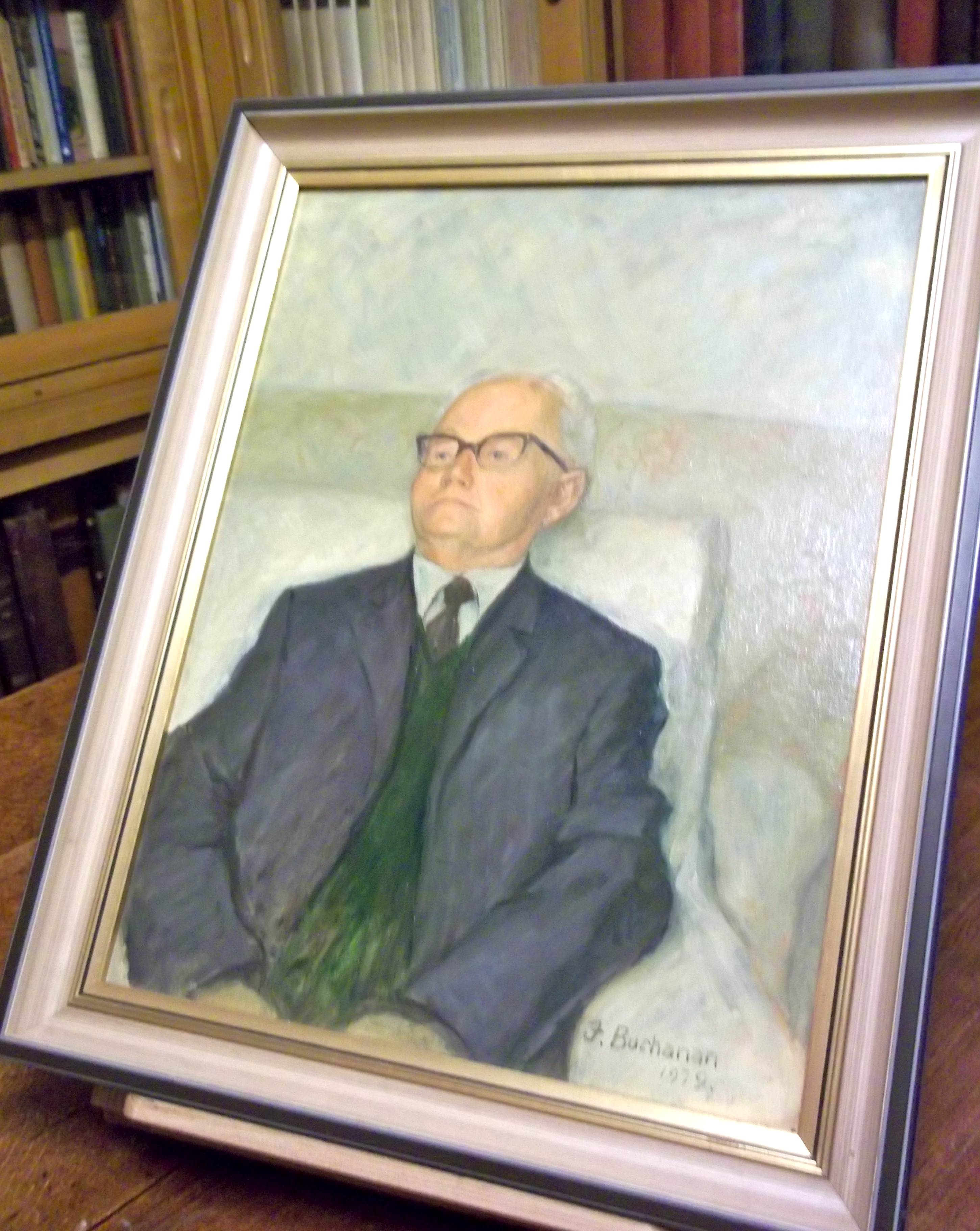
100_4733We now know that, in the event, the honour of Laureate was conferred upon Sir John Betjeman on the 10th of October 1972, and that the aspirant speculation of the Lichfield and Tamworth Magazine was futile. But there are more ways than one for a poet to acquire posthumous fame. It came to light after Albert Sperrin’s death on Valentine’s Day in 1987 that he had bequeathed to Lichfield City Council a portrait of himself in oils. Years later, details of the portrait, by artist “J. Buchanan” made it to the list which the Public Catalogue Foundation compiled of publicly owned art. In collaboration with the BBC, the database is now available online, so that by making a Google search of albert+sperrin+poet you are rewarded within seconds by the view of a round, bespectacled face, and, additionally, the opportunity to read the verse which Sperrin composed to mark the Mexico Olympic Games in 1968.

Albert Sperrin (1903–1987) by J. Buchanan. Date painted: 1979 Oil on canvas, 53 x 42.5 cm

Albert Sperrin (1903–1987) by J. Buchanan.
Date painted: 1979
Oil on canvas, 53 x 42.5 cm

Mrs. Jo Wilson, the curator of the Samuel Johnson Museum in Lichfield was kind enough to retrieve Albert’s picture from the archive for my perusal. She commented that the relaxed, informal pose of the sitter intimated that the artist, J.Buchanan and his subject were personal friends. The composition of the picture, with Mr Sperrin sitting comfortably in his armchair with a patterned sofa partially visible in an awkward position to the rear suggests to me that we are privileged to be looking at the interior of 95, Gaia Lane.

The portrait seems to have gone on public exhibition in Lichfield in 1987, accompanied by some of his letters and manuscripts.  A short biography written to accompany it reinforces the impression of a good hearted, traditional British eccentric, a “generous man always ready to write a poem for a good cause.” His subject matter ranged from Royal events to the Bradford Football Ground fire, and the artistry of Torville and Dean. His is described as an “idiosyncratic’ style,  which charmed and delighted local people – which I am sure is a fair description.  Touchingly patriotic, Albert Sperrin’s work is part of a long tradition of versifying about events of national importance, which goes back to a time before mass media or widespread literacy when reading rhyming accounts out loud was a useful way of communicating news.

Faults in meter and stress, and some instances of oddly archaic language are easily overlooked when Sperrin’s writing has such brio. Haven’t the devoted fans of William Topaz McGonagall, guilty of far more brutal shoe-horning of words into lines remained faithful and evangelistic over 100 years after his death?  ( He died 6 months before Sperrin was born – although it is said that Sperrin met Rudyard Kipling in his youth, who encouraged him in his writing)

Like Sperrin, McGonagall sought Royal patronage for his efforts. He dubbed himself “The Queen’s Poet,” and walked 60 miles to Balmoral in a violent storm to present a performance of his work to her.  He did not meet with success either, and received no accolade from his monarch.

But how bad a Poet Laureate might Albert Sperrin have made?  Sir John Betjeman, the successful candidate, did not enjoy the job, and, according to a press report of the time received news of his appointment with luke-warm enthusiasm:

Sir John Betjeman will write only when moved, and otherwise “remain a silent thrush.” said the Guardian on the 11th October 1972. It went on:

He asked yesterday, on holiday at a cottage in North Cornwall: “Isn’t that a beautiful remark? I just made it up. Poetry is poetry, whether you are Poet Laureate or not. It has to be felt. I don’t think I shall write about public occasions unless I can feel them, it is better not to write than to write badly.”

Our local bard would have displayed no such reluctance, I feel sure.

To Sir Francis Chichester, Britain’s lone around the World Yatchtsman and Flier – by A.E.Sperrin

Let guns boom out, let flags fly at ship’s mast,

Sir Francis Chichester is safely home,

Let planes dip in salute as they fly past

Over his yacht; no more is he alone;

This man who journeyed round the world on sea,

Marking his name in Britain’s history.

This flying ace, this ocean pioneer

Britain’s loved crusader named Chichester,

Undaunted by mishaps, unmoved by fear,

A man of courage, an adventurer;

Flying to Australia o’er land and sea,

Alone, but for his Gipsy Moth for company.

Around the world he flew, always alone

The sea and land below, the sky above

The cockpit of his aeroplane his throne

The Gipsy Moth he flew in, his air-love;

Flying from New Zealand o’er the Tasman sea,

Reaching Australia, and making history.

Airman, now turned sailor, fearless, bold and brave

With Gipsy Moth the Fourth as his steed.

Sailing upon the ocean, his untiring slave,

Willing at his command to give more speed:

White sails at her mast-head, billowing in the breeze,

Gliding her along o’er the windswept seas.

Alone around the world he rode the seas,

Through dreary days and nights for weeks on end.

Into the unknown, lashed by the wild sea breeze,

Enduring loneliness without a friend

The sun and stars above his visual guide,

The yacht he rode with his love and pride.

Stately she rode her Captain standing by

Crossing the Atlantic Ocean on her way.

Speeding along, her main-sail flying high

Nearer her destinations day by day.

Alone, the Captain and his sea-worthy friend

Riding the storm-tossed waves unto journey’s end

Together, yacht and man rounding the Horn

Tossed upon mighty waves, then lost beneath the spray.

Was ever there a braver yachtsman born?

Or yet a yacht which gave such staunch display?

High on a sea-borne mountain, then tossed below,

Into the boiling ocean, backwards, to and fro.

Salute this hero over the country wide!

Salute this gallant yachtsman on this day!

Citizens of Britain, look on him with pride,

As Plymouth celebrations get underway.

Receive, Sir Francis, the hear-thanks of our Nation

And the statuette of Plymouth’s presentation.

The scene is set with regal pageantry,

As Sir Francis kneels before our reigning Queen.

This day of June, -repeating history

When another Francis stole the historic scene,

Using the trusted sword of Sir Francis Drake,

These epic words Her Majesty bespake;

“Arise, Sir Francis, receive the honour due,

The accolade of Knighthood I bestowe on you.”

Posted in Uncategorized | 6 Comments

Memory at my bidding.

100_4748

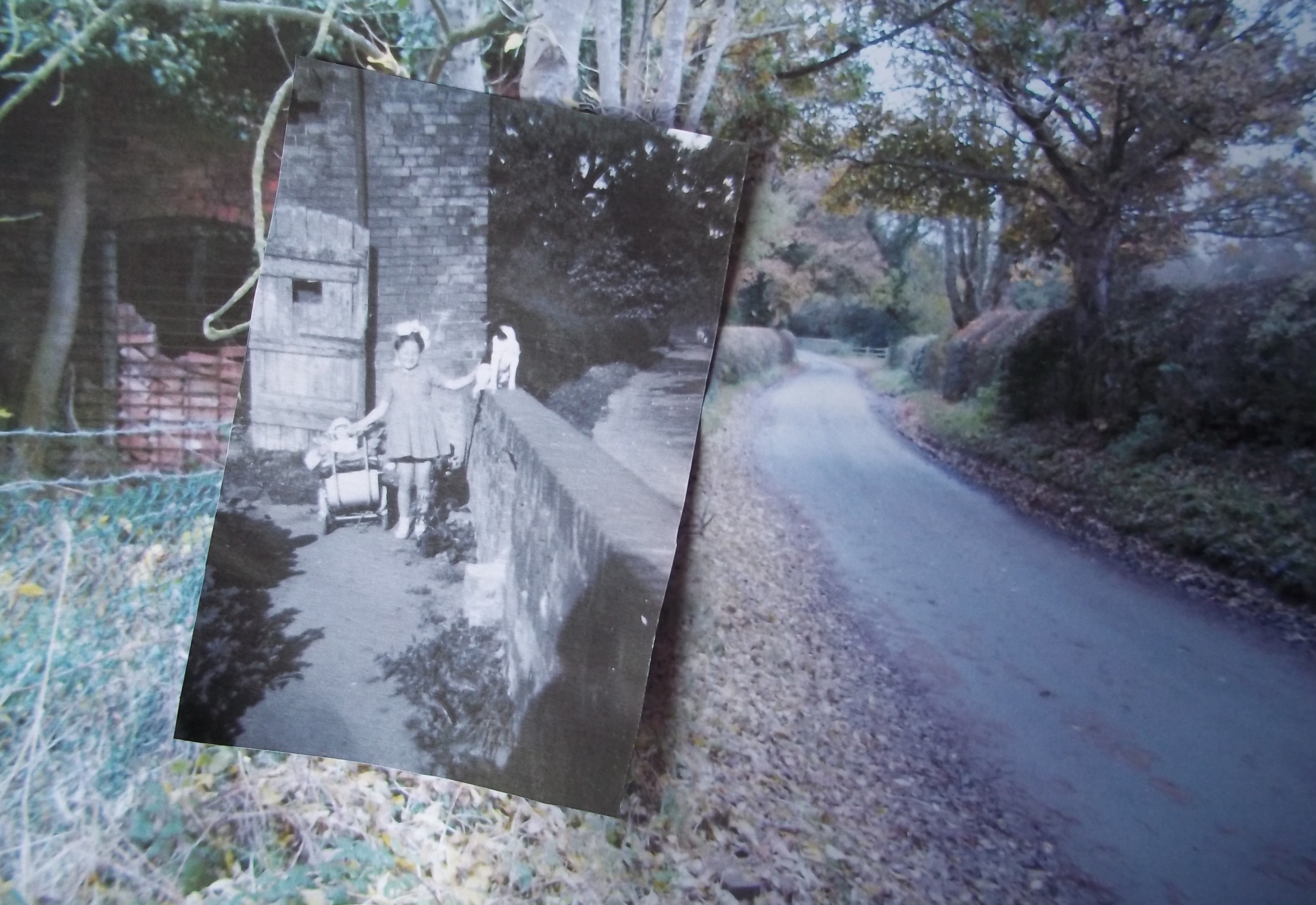
Footherly Lane, near Stonnall. August 1950, and November 2012.

Over the years since my Uncle Bill’s death in 1982, I have regularly taken a less then necessary detour along Footherly Lane, and permitted myself intermittent wincing glances at Keepers Cottage.  Over the course of half a century, it was home to three generations of my family. Peering through the windows after it had been empty for eight or ten years, we could hardly believe that the tiny rooms could have accommodated the extended Horton family for Sunday Teas, and death-bed vigils, but they did, and with its extraordinary,  time-capsule characteristics –  the unspoilt rural setting, the well water, the paraffin lights, and the earth closet – the place assumed a mythological status in our imaginations, and still haunts me in dreams.

My inner eye has compiled a little flip-through book of images over the intervening, uninhabited, years of the little dwelling, its boundary wall, and its outbuildings, as they have sunk gradually, incrementally, to their rendered red brick knees onto the soft, loamy soil.  Windows are now bricked up and blind, and chimney pots long toppled. The field which comprised the small holding is overgrown. However, the wood and the stream by which it is bounded look much the same, and the precise curve of the lane down to the bridge over Footherly Brook is unchanged from the sunny August day in 1950 when my Dad took a snap of his niece, Josephine Anne, her refined, well dressed dolly, and Bob the dog.

It must come as some shock if you have the misfortune to suddenly revisit, after a long interval, a beloved building, now decayed, which you remember in its prime. Surveying the scene must be like viewing one of those ambiguous optical illusions; drawings which simultaneously depict, say, either and both a rabbit or a duck. Or Rubin’s vase whose outline is composed by the silhouettes of two faces in profile….images of which either one or the other can be seen at one time, so that the brain flips back and forth between the different perceptions. Or, is it always possible to be aware of the sharply defined picture, drawn from memory, superimposed upon the deficient and unreal dreariness of present facts?

Augmented reality technology will one day – soon – be able to mimic the natural phenomenon of seeing the landscape of your past as you plant your feet on today’s unforgiving ground. I discount the obvious application of  “A.T.” glasses or contact lenses feeding sat nav data seamlessly into your field of vision.   My thoughts rush to the possibility of enhancing my view of the 21st century streetscape of an historic city such as Lichfield by generating transparent images of now indiscernible thoroughfares  – or of buildings long demolished. And of populating them with shadowy animations of the denizens of the city going about their business as they would have looked 50, 100, or 1000 years ago? Wouldn’t that be winning way of engaging with history?

For now, I must be content with my own internally perceived web of visual recollections. Perhaps you experience them too? Walk up the comfortable incline of Greenhill from Lichfield’s commercial centre, turn left, and walk on between the townhouses, a happy melding of old and new, which have been christened “Greenhill Mews.” At the end, are you ever still arrested by the sight of the undulating roofline of the “new” Tesco superstore, which opened in 2009, having seen, in your mind’s eye, the “older” store, a mere 10 years its senior? There was no windowless booth of a “Costa Coffee” in the earlier, squarer, edifice. To the left of the main doors was a spacious and convenient café. In there, my parents and I raised celebratory hot beverages after a property auction sale in the – also now long gone – Lichfield Civic Hall. Winterton and Sons’ gavel had fallen in my favour, and our future marital home, our very own Keepers Cottage, had been “knocked down” to me.

100_4147

Part of “Greenhill Mews.”

And speaking of auction sales, can you, like me, picture an even older incarnation of this elevated acre of Lichfield, recalled in the name of the street called “Smithfield Rise”, on the north-west side of the Tesco store? Until the site off Church Street was cleared to make way for the supermarket in 1988, Winterton and Sons, auctioneers, operated, as their family had done for over a century, the busy Lichfield “Smithfield”, or livestock market, there. The Victoria County History of Stafford tells us that:

in 1883 Thomas Winterton began building a covered market in Church Street. There was a street market for horses once a month by 1879, and it was evidently still held in 1889. By then the smithfields were selling cheese, poultry, bacon, and potatoes, to the detriment of the general Friday market. An annual wool sale was started at the Greenhill smithfield in 1884 with some 4,000 fleeces advertised, and by 1892 some 32,000 were pitched there. In 1927 the Church Street smithfield dealt in cattle, sheep, pigs, wool, and potatoes on alternate Mondays and in horses on the first Friday of the month. A livestock market was held there every Monday from 1935.

The old walls, which have been incorporated so congruently into the dwellings which form Greenhill Mews, I knew in the 1970s as part of the buildings which housed the stock on Monday market days. Thrillingly, every fourth or fifth Thursday, the ridged and gullied concrete was scrubbed and sluiced even more vigorously than usual, and,  in the stalls, ponderous examples of Victorian furniture jostled for space with pictures,  sets of books tied with string, baskets of china, and the mysterious and most desirable boxes of “miscellaneous items”, which were sure to contain a priceless treasure in their dusty nether reaches.

Attending the sales held much excitement for me.  Michael Winterton, attractive, charismatic, acerbically witty, was wheeled, by minions, on his platform around the lots.  He winked at the girls, and humiliated, with cutting remarks, whoever had amateurishly waved or gestured within his field of vision and yet had not intended to make a bid.  How pleasurably my heart pounded when I first secured a lot by bidding for it myself, handed over my pocket money to the clerk, and took home my prize. The risk!  The drama! The smell and glory of being freely able to handle and inspect the time worn chattels of another man’s household!

Auction-going then was a minority sport.  “Flog it!” was decades from being aired on TV screens.  Even “Going for a Song,” the only, po-faced, antique TV programme of the day, had yet to be superseded by “Antiques Roadshow”.  Items which would effortlessly slip into the  Art and Antiques category of EBay today were as yet not even “Collectables” –  mostly just someone else’s junk, but endlessly fascinating to me!  “That’s a dealer,” my dad might say to me, indicating with his eyes, but without moving his head, some eccentric looking person who might have been Colonel Mustard or Miss Scarlett. I was a rapt observer of this arcane world, in which I felt I belonged.  The porters, in their matt brown cotton coats lifted their eyes and greeted my dad by name: “Worro, Ted.” “Worro.” “Worro.”

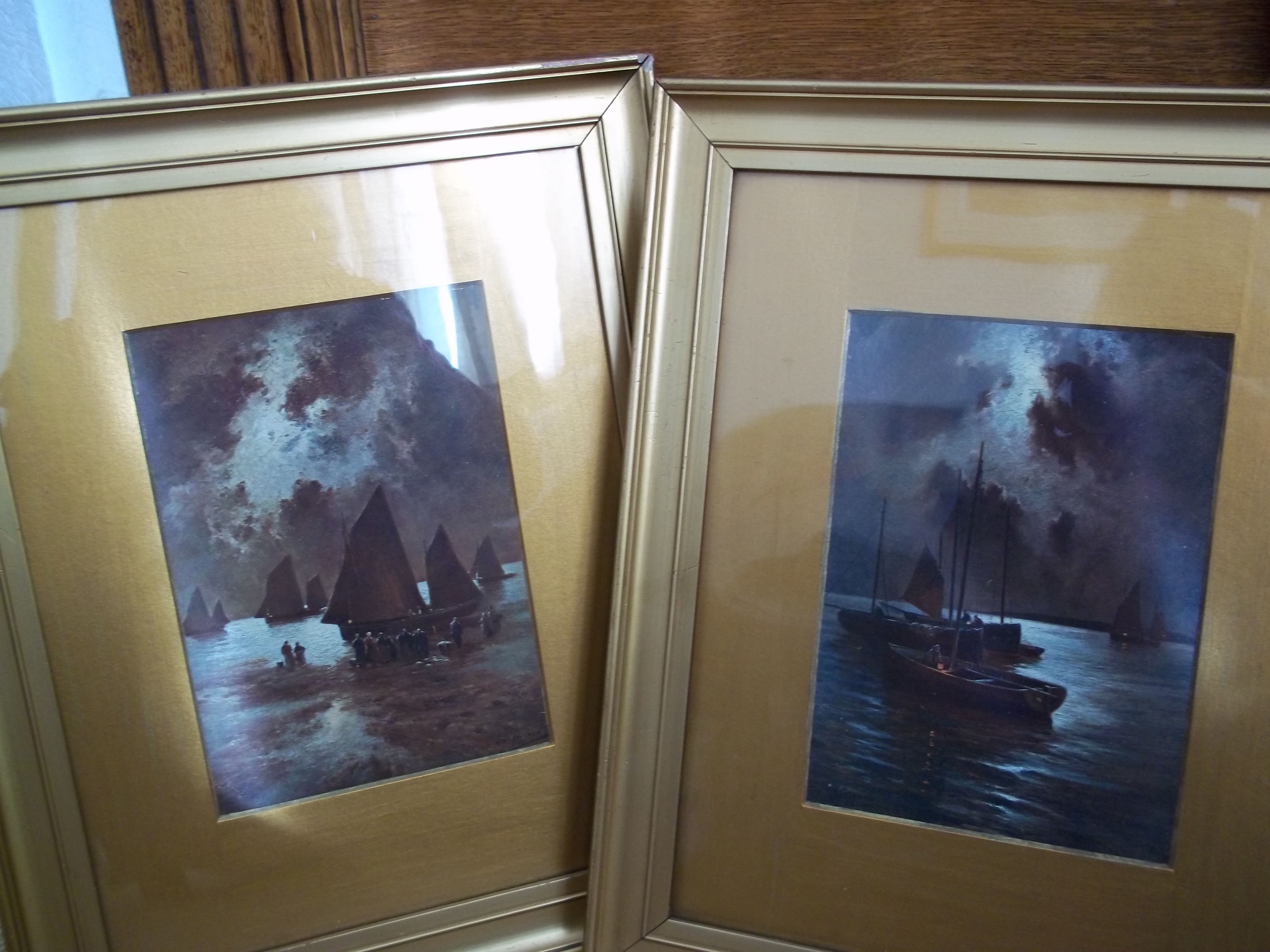
My father bought these rather gloomy, continental looking seascapes at the Wychnor Hall sale in 1976, having been outbid on some Stevengraphs which he fancied better.

If the contents of a larger house were to be auctioned, the auctioneers would decamp to the site.  Mohammed would go to the Mountain. An enormous marquee was erected on the lawn of Wychnor Hall, in that long hot summer of 1976, where the copious contents of the building were sold off during two days, following the death the previous year of its gentleman owner of 30 years, William Harrison, the scion of industrialists, inheritor of their wealth, but father of daughters only.

The River Trent babbled refreshingly at the foot of the gardens, but it was humid in the marquee.  It seems audacious of us now, but Mom, Dad and I snook into the cooler interior of the Hall, and found it to be deserted.  Having started the job, we finished it, and the memory has never left me of climbing ever narrower stairs to the top floor, where we peeped into an abandoned nursery containing a shabby rocking horse with a mangy mane draped in spiders’ webs.

100_4749

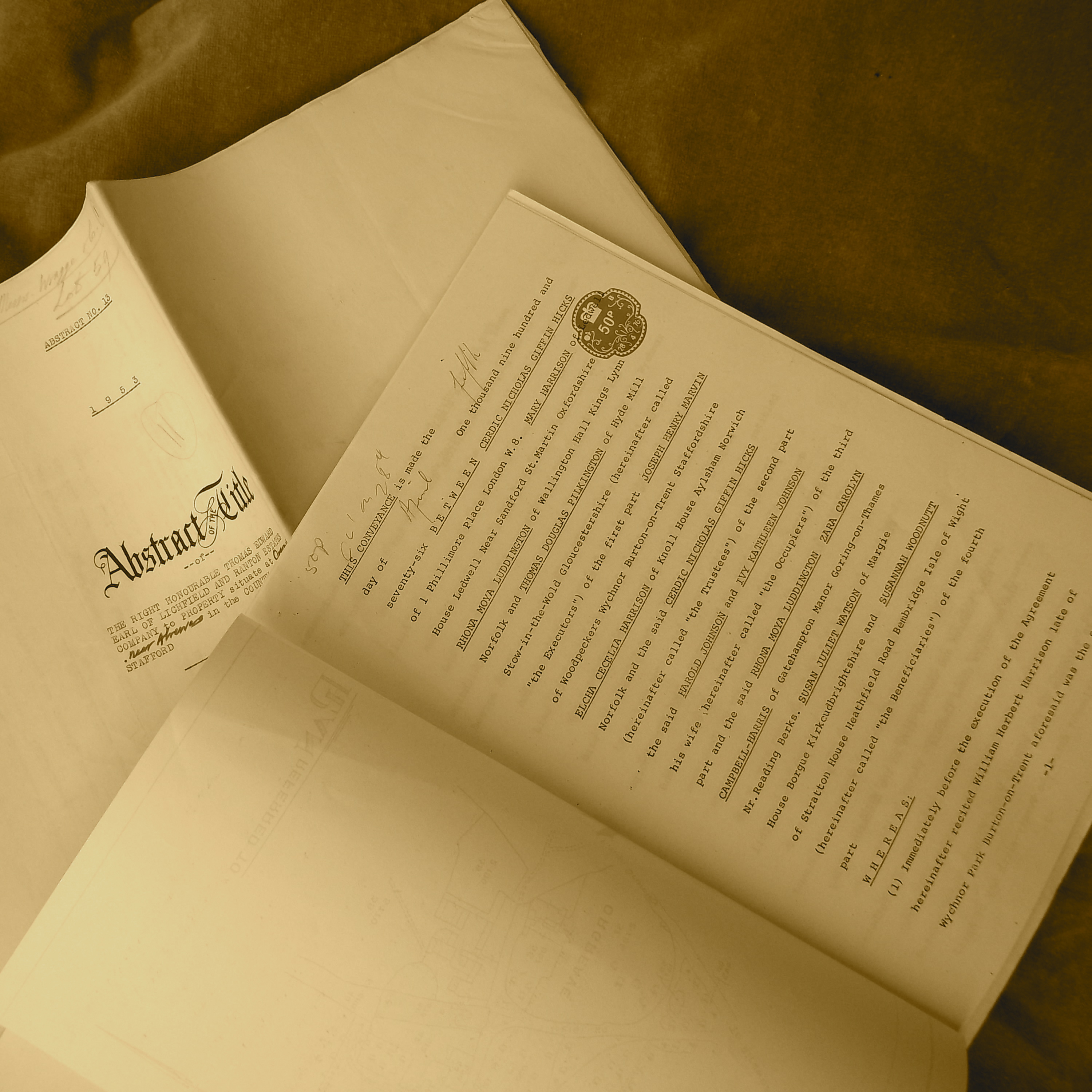
The document, signed by Mr Harrison’s heirs, conferring the right of tenure on his gamekeeper, Mr Johnson, and his wife, in 1976.

When his boss died, William Harrison’s Gamekeeper, Harold Johnson, was forced into an early retirement.  His service, rearing wild game, preserving the hedgerows and copses of their habitat, and organising shooting days for Mr Harrison and his aristocratic guests, had begun not long after the days when the Harrisons were tenants of Orgreave Hall, on the south bank of the river, and it was in Orgreave that he had remained living in his tied cottage. In accordance with Mr Harrison’s wishes, a legal document was raised in April 1976 to confer on the Johnsons the right to reside in the Keepers Cottage for just as long as they wished.  In fact, that was to be until 1991, with Harold dead, and Ivy ready to move into sheltered accommodation, precipitating that sale at the Civic Hall at which I was the successful bidder.

100_4735

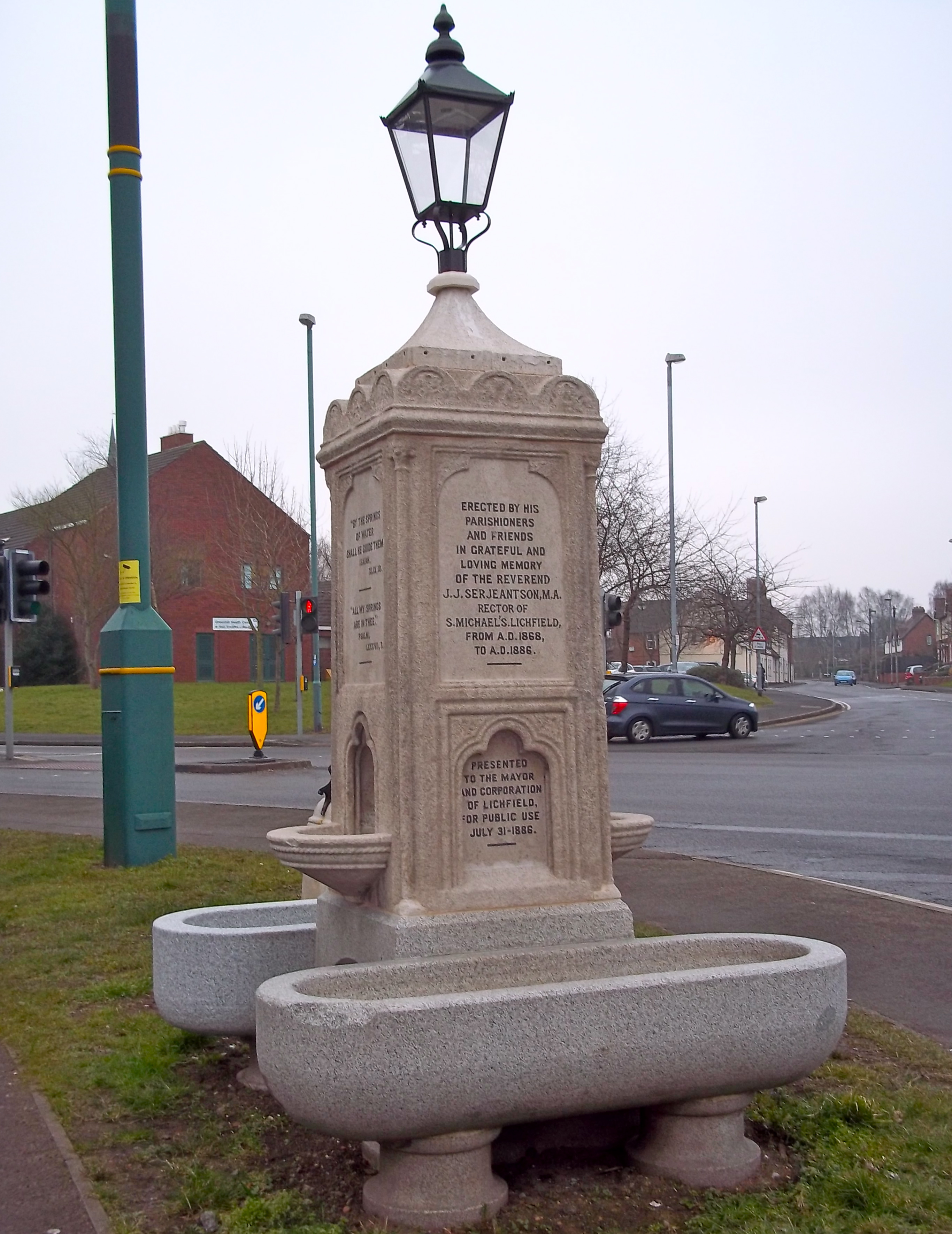
The Serjeantson Fountain, Greenhill, Lichfield.

What is there to remember the Greenhill Smithfield by now?  Well, the Serjeantson Fountain, built by public subscription as a memorial to the Reverend James Jordan Serjeantson, 19th century rector of St Michael’s Church has been restored and repositioned in Greenhill. It sports capacious stone troughs for the refreshment of the livestock which would be arriving in Lichfield from the surrounding countryside each Monday for the auction sales.

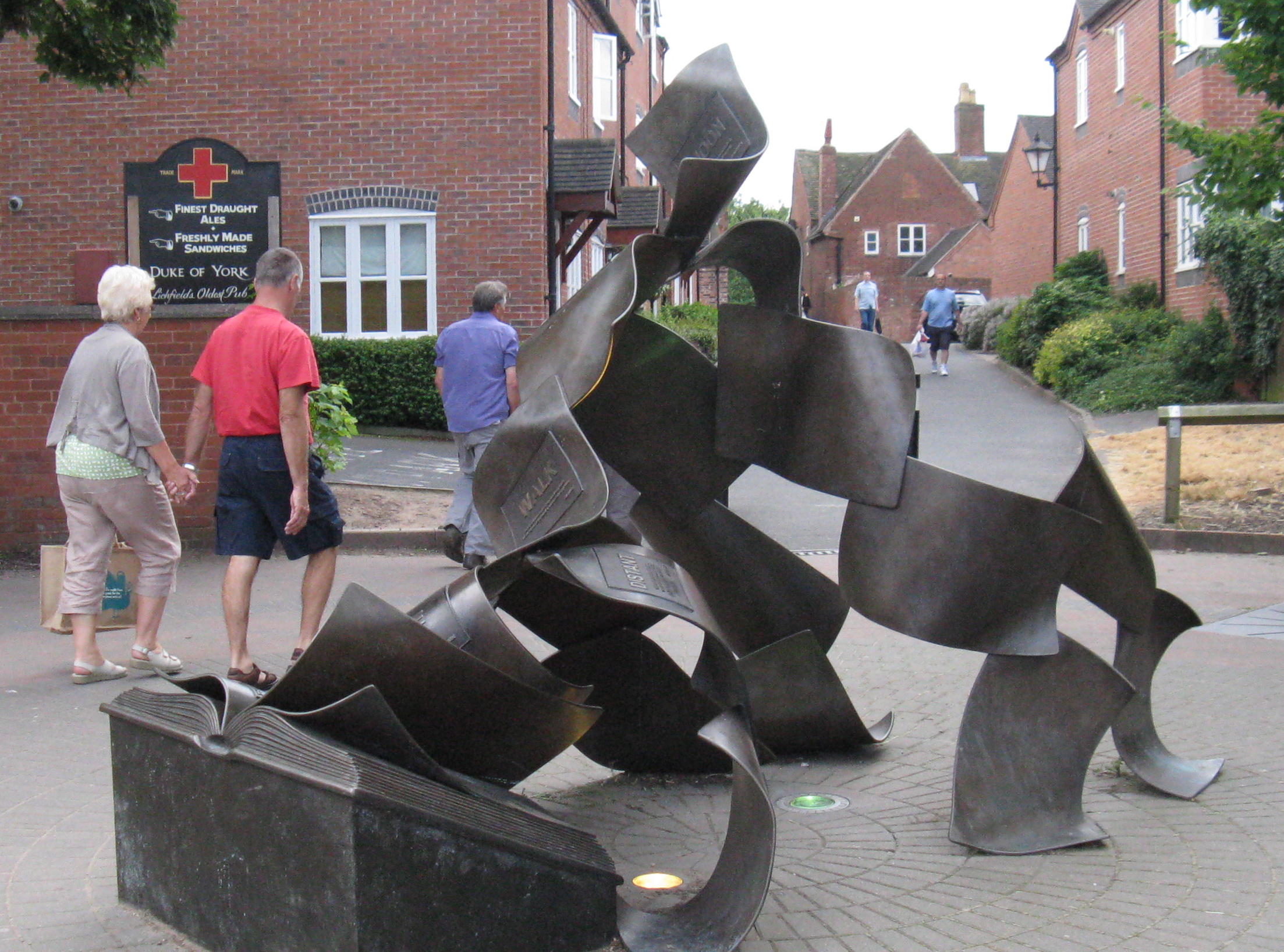
At the Tesco end of Greenhill Mews is “The Formation of Poetry,” by Lichfield born sculptor Peter Walker, which was unveiled in September 2010.  It is a dramatic tribute to the life and work of Samuel Johnson, in the form of an animated dictionary from which choice pages are cascading away. The title of the work refers to Johnson’s method of using poetical quotations to establish the meaning of words. These include “Sleep,” ; “Walk”; “Moon,” “Cloud,” and “Rose”, with supporting quotations from verse.  “Worro,” does not appear in the famous dictionary, although it is a word which must surely have been heard in the Lichfield of Johnson’s  youth. I have a hunch that it, like its upper class relative, “What Ho!”, can be traced back to the earliest of English poetical sources……..

Hwæt! We Gardena    in gear-dagum,
þeodcyninga,     þrym gefrunon,
hu ða æþelingas     ellen fremedon.

Begins “Beowolf.” – (Lo! We have heard of the might in days of yore of the Spear Danes, kings of the people).  Hwaet! The bard says, as he hails his fellows in the vast smoky hall and calls attention to the fact that his recitation is beginning.
“Worro,” Jeeves!  
“What Ho, Aynuck!”
IMG_0990
Posted in Uncategorized | 7 Comments

A Father/Daughter Bond

100_4618

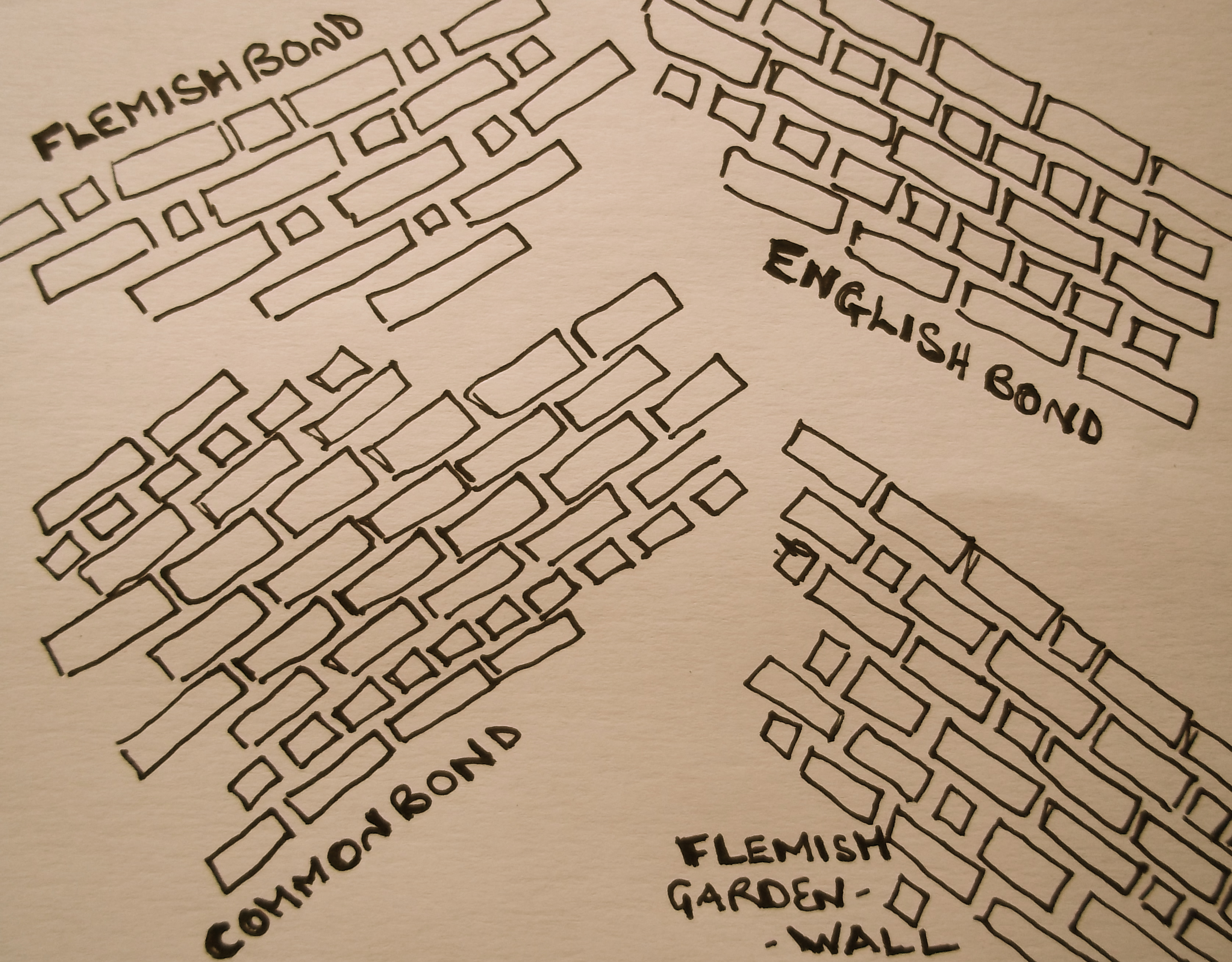
When I see an old wall, I look at the pattern of the bricks to determine the bond. When I name the bonds, as at many other times, I think about my father.

When I was a little girl in the 1960s, my father, a self employed builder, worked very long hours. If I was lucky, he arrived home on weeknights before I went to bed, and I was allowed to perch on his knee and share a few mouthfuls of his dinner, which Mother would have kept warm between two plates on top of a saucepan of simmering water on the gas hob. The crusty shore at the edge of the plate gave it a distinctive, delicious savour which endures in my memory.

Mom was, and is, a “good, plain, cook”, and our evening meal was wholesome but unvarying: vegetables, which were often home grown, and meat, the plated-up arrangement topped by Bisto gravy.  Chops, mince, liver, braising steak,  or a smallish roasting joint were purchased twice weekly from Mr Cope’s shop on Aldridge High Street. With gloved hands – sheepskin in winter, cotton in summer, leather in-between – Mother pushed me on the mile and a bit journey to “the village” and back again in my tinny-metal, sky-blue push chair on fine days, or bundled me onto a bone-shaking “Harper’s” ‘bus in foul weather.

By the 1970s, the componenets of our evening meal would have been lifted out of the ponderous sarcophagus of a chest freezer which stood in the ex-coalplace just outside the kitchen door. (The hated – by Mother – Parkray having been superseded by the clean convenience of gas central heating.)

Seasonal gluts of produce harvested from our own garden and from the field at Keepers Cottage could be thriftily preserved in that freezer, and it was less than irrelevant that Walter and Geoff Yates of Yieldfields, Bloxwich, were amongst my Dad’s customers at that time.  He worked on their slaughter hall as well as the family’s houses.  I remember Mrs Yates’ huge warm kitchen one cold Sunday morning, and my diminutive self being pleasantly overwhelmed by two huge and enthusiastic, gritty mouthed Bassett Hounds. It was to be in another, far away abattoir, a quarter of a century later that I met my future husband…..but that’s another (romantic) story.

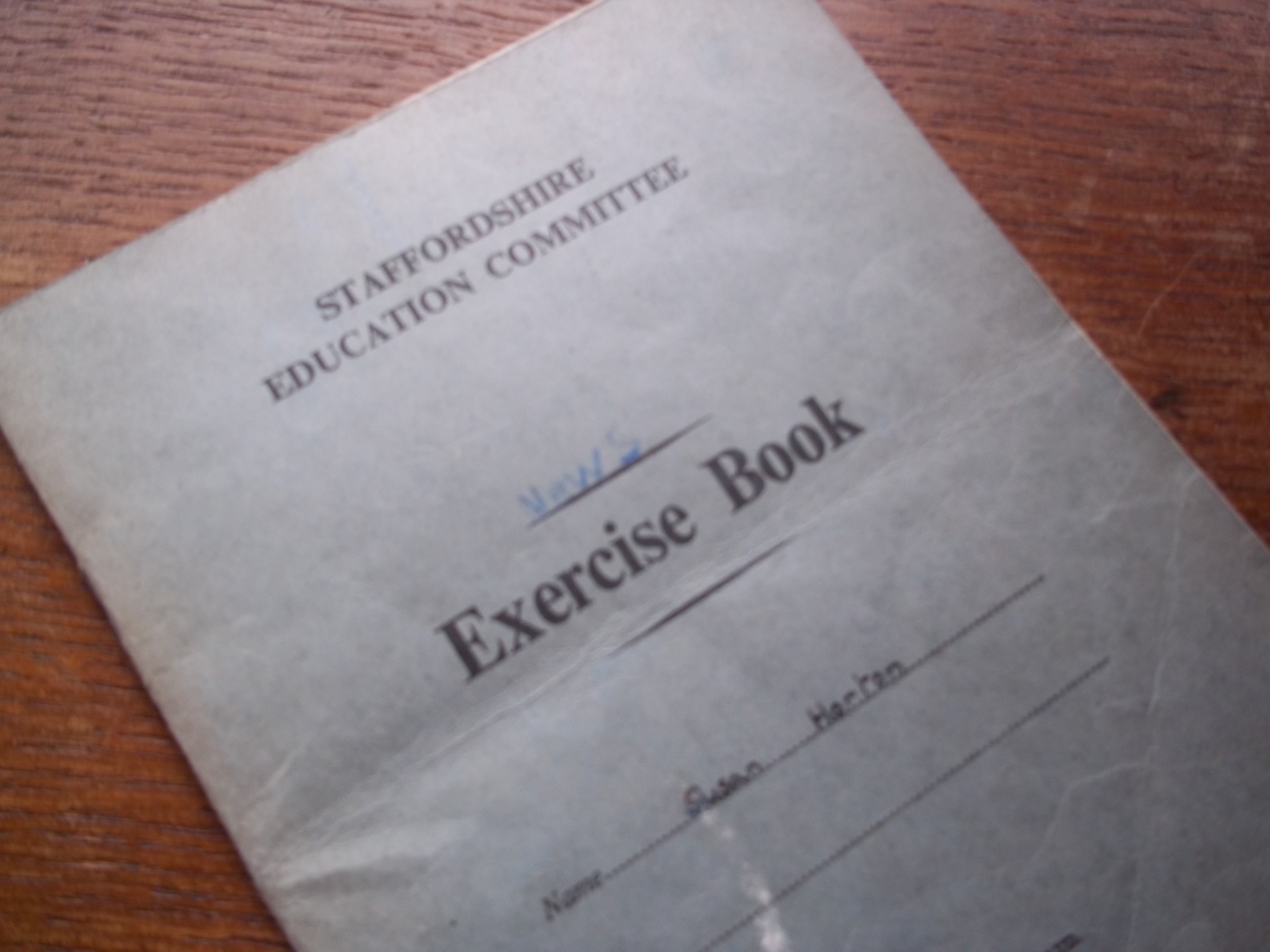
100_4619Childhood Sundays with my dad were delightful. At Redhouse Junior School,  Monday morning’s “News” in my blue exercise book sang of my carefree and  interesting week ends.  In this 1968-9 “volume”. punctuation is dodgy, and some of the spelling is a damning reminder of the misguided fad that was I.T.A.  – The “Initial Teaching Alphabet.”

100_4623

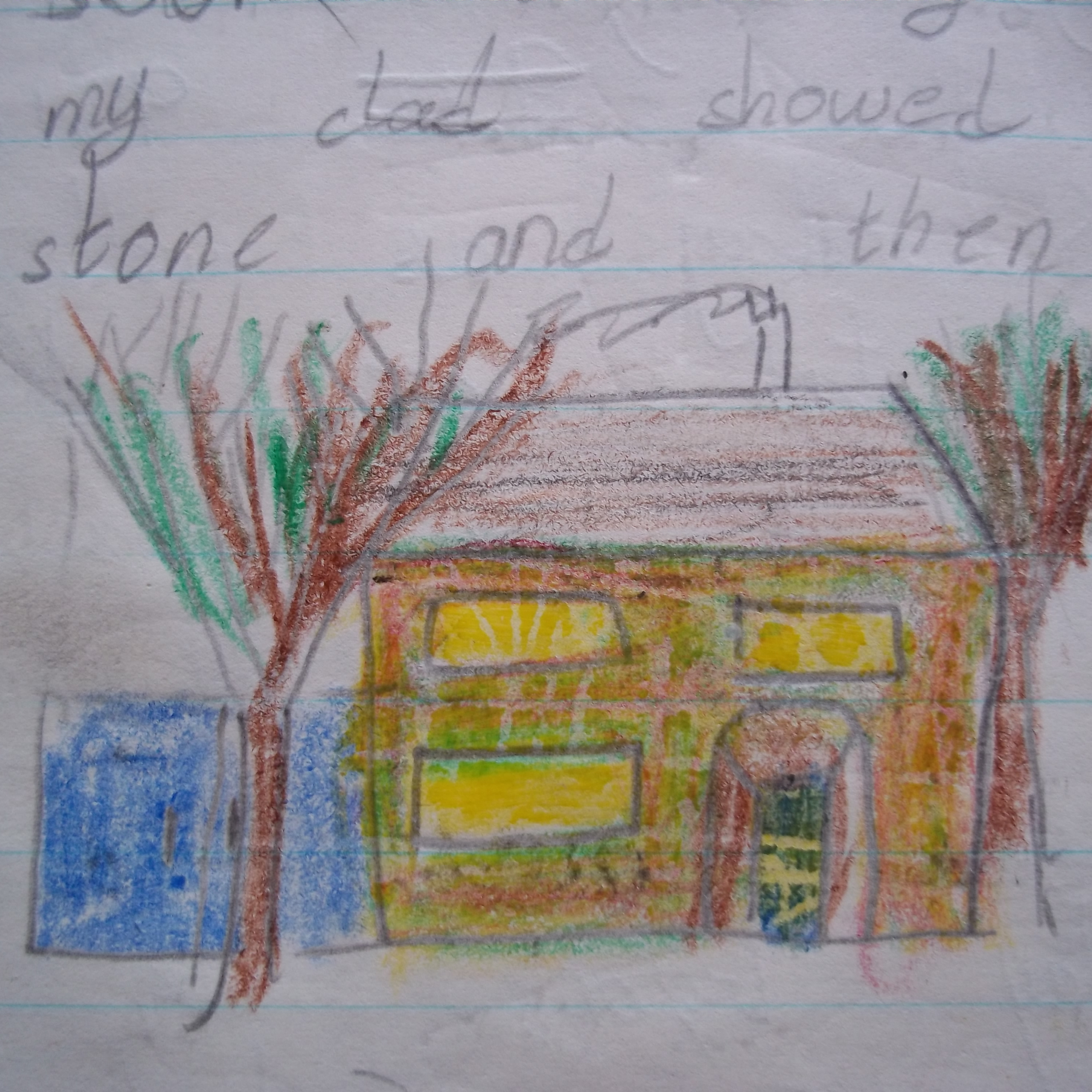
4th May 1969: “On Sunday before we went to my Grandad’s we had to call at a place were my dad was working it was in a Private road called Birch Grove it was coverd in birch trees it was very hot and I felt like taking All! my clothes off! the houses were very posh and as we drove along I could read the names on the gates. soon we got there and my dad showed the people the stone and then we came home.”

There were visits to be made on Sundays, and my dad was happy to have me to himself, by his side, as he helped his customers to choose stone for their fireplaces, delivered estimates for jobs, or dropped a gentle hint about payment over tea and biscuits. The day always started well, too: When Mom vacated her side of the bed in the morning, I might slip between the sheets beside my bulky, cosy dad and read to him a couple of chapters from the Enid Blyton canon. Or we might be up first, and while Mother sipped tea, propped against a wynceyette pillow, bleary eyed, I would cheer my dad on as he wielded the sizzling frying pan, concocting the sort of “Full English” which Mom frowned on then, but was later forbidden entirely after my dad’s heart attack in 1972.

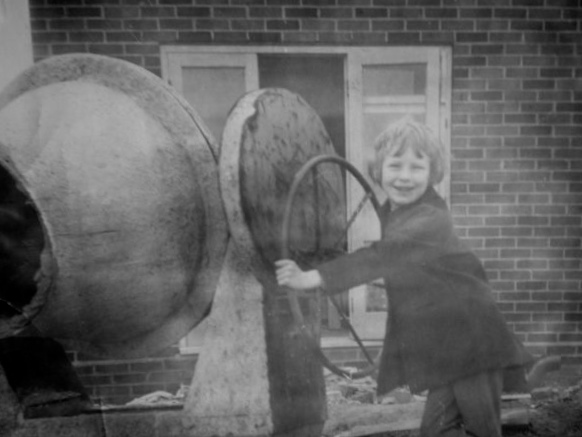
Taking a keen interest in concrete.

Taking a keen interest in concrete.

My curiosity, and my father’s eagerness to instruct were in harmony with each other as we set off on our Sunday rounds in the 1966 Ford Thames van, our family’s only vehicle.

At some customer’s quaint, unspoilt rural cottage (a speciality), or at a boxy modern house, or the grander home of decayed minor gentry in Four Oaks or Little Aston, the building job would be explained to me.

 Rafter, purlin, truss, noggin, and facia; header, stretcher, weather-struck, raked:  The vocabulary of carpentry and bricklaying was at my command from an early age. We called in on my dad’s Pop and brother Bill at Keepers Cottage, and where Footherly Woods met the bottom of their field was a magical Sabbath playground for us.

100_4622

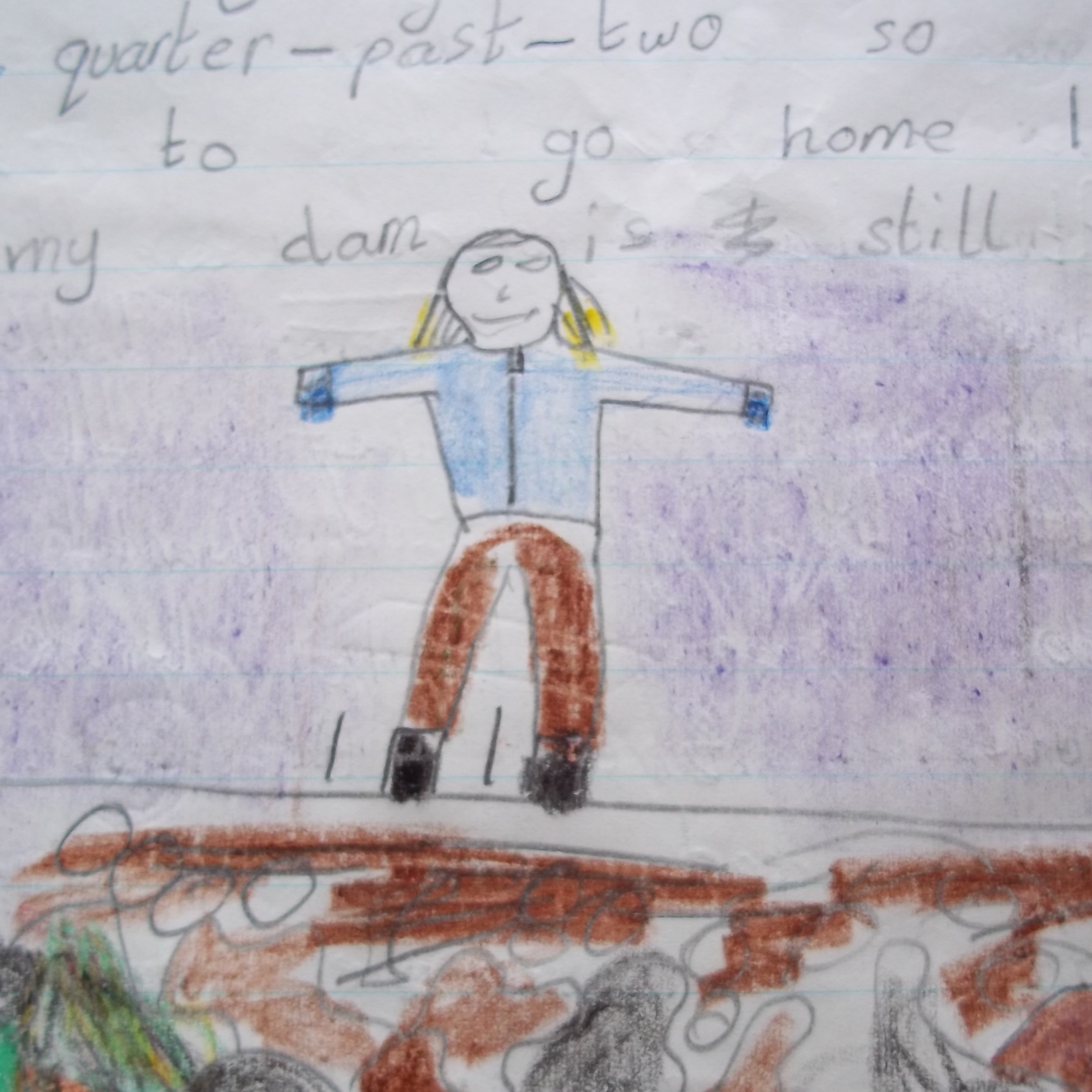
May 11th 1969: “The Dams. On Sunday, we went to Grandads we were a bit late because my dad had to deliver some horse manure to Mr and Mrs Sadlers. I thought that Mr Sadler was mad when he said the wife’s in the garden it was more like a park. At last when we got down the wood it was nearly twenty -five-to-two. Straet away we went down to the little brook that runs into the river my dad made a dam and I made a dam then all of a sudden my dad moved his dam away and my dam was drowned. I built my dam up again soon the front was made of stones and backed with mud and leaves then Suki walked up and nearley got stuck. Soon it was quarter-past-two so we had to go home I hope my dam is still there.”

 Streams could be dammed, flowers named and gathered, trees climbed, and wildlife excitedly identified, and, as I reached my teens, shot at.  I trembled, and missed my target because of my great reluctance to kill.  During my  “training”, I wielded only my lighterweight .410 shotgun, with its beautiful walnut stock, which had been made to measure for my Uncle Bill by Thomas Wild’s gunsmith in Birmingham before the war.  My dad had painstakingly beat out an old silver sixpence, engraved an elegant copperplate “S” on it, and set it into the stock of the gun for me. With skilful stitches, a relative’s stiff ginger leather “Sam Browne” belt from the First World War was cannibalised into a cartridge belt for .410 sized cartridges.  What a painstaking, loving gift! I was paralysed by guilt on either hand: I abhorred the thought of being less competent than any lad would  be at shooting or fishing, and frightened of garnering less accolades than I might from my beloved parent, but I passionately resisted the idea of inflicting pain on a beautiful bird or animal.

But what was part of my father’s identity I absorbed as part of my own. My father told me that as soon as he had been strong enough to hold a gun, he had been accustomed to stand under the holly bush at the bottom of the field at Keepers Cottage, watching for pigeons – (or pheasants put down by the Footherly Estate) – coming in to roost in the conifers in the corner of the wood. Not far into his teens, he began building work with Pop and Bill.  Uncle Bill was a foreman for J.R. Deacon in Lichfield until around 1980, and my dad served his apprenticeship there too, before the war.  Then Adolf intervened.  Service with the 1st Battallion of the Welsh Guards saw my father busy in the armourer’s workshop, pursuing his interest in firearms for King and Country, against the backdrop of conflict in early post-colonial Palestine, until, in 1947, gun yielded once more to trowel and mortarboard.


A family tragedy saw guns put aside for most of the 1960s.  They were innocent years. How fine it was, when constructing sand castles on a summer beach, but also in the snowy winter garden, to have a father, so skilled in laying bricks, with Sunday hours to give to you!

CNV00003

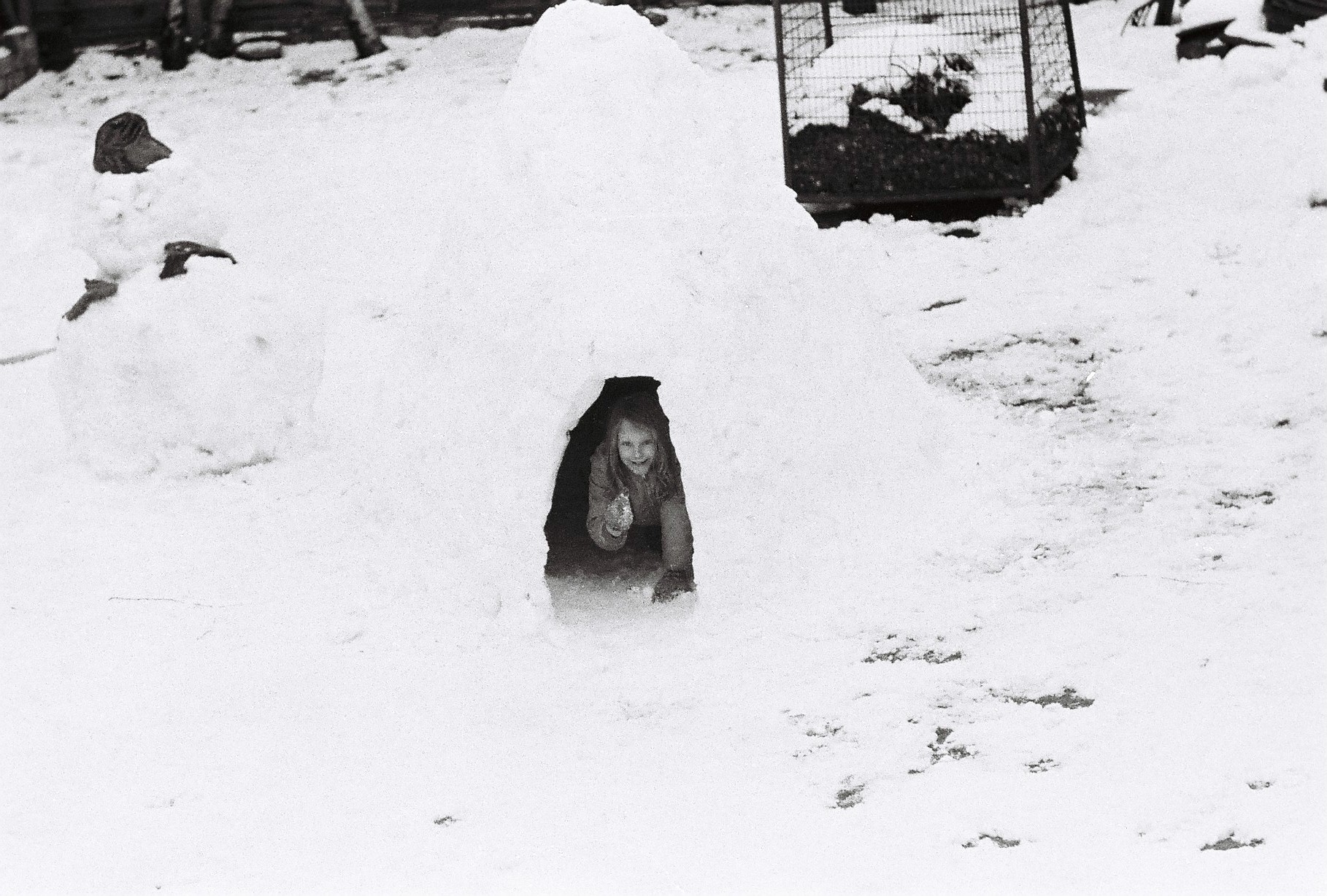
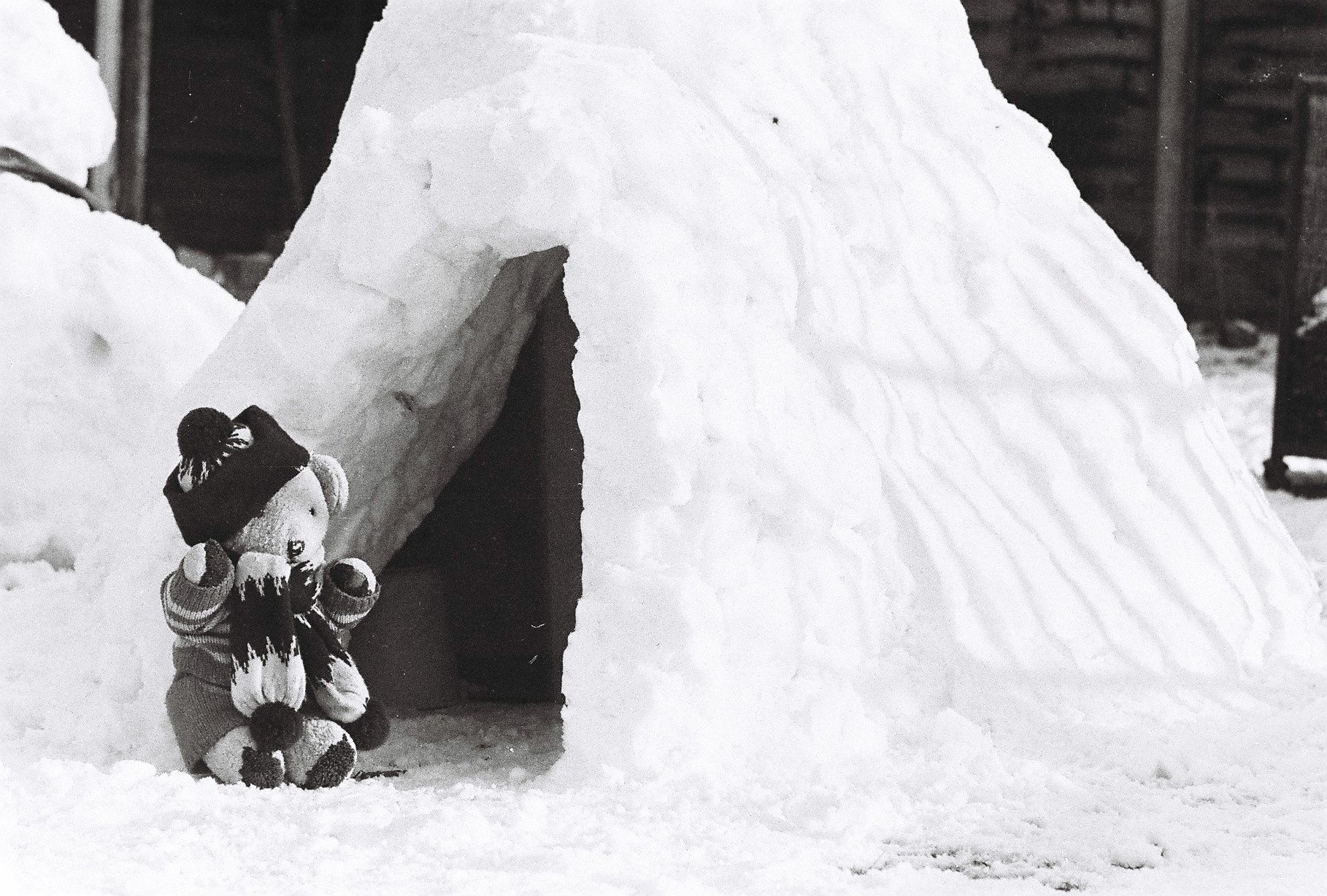
A snowman and and igloo from snowfall in Bosty Lane, Aldridge, 44 winters ago.

CNV00001

A youthful Big Ted takes care to wrap up warm when venturing outdoors in February 1969.

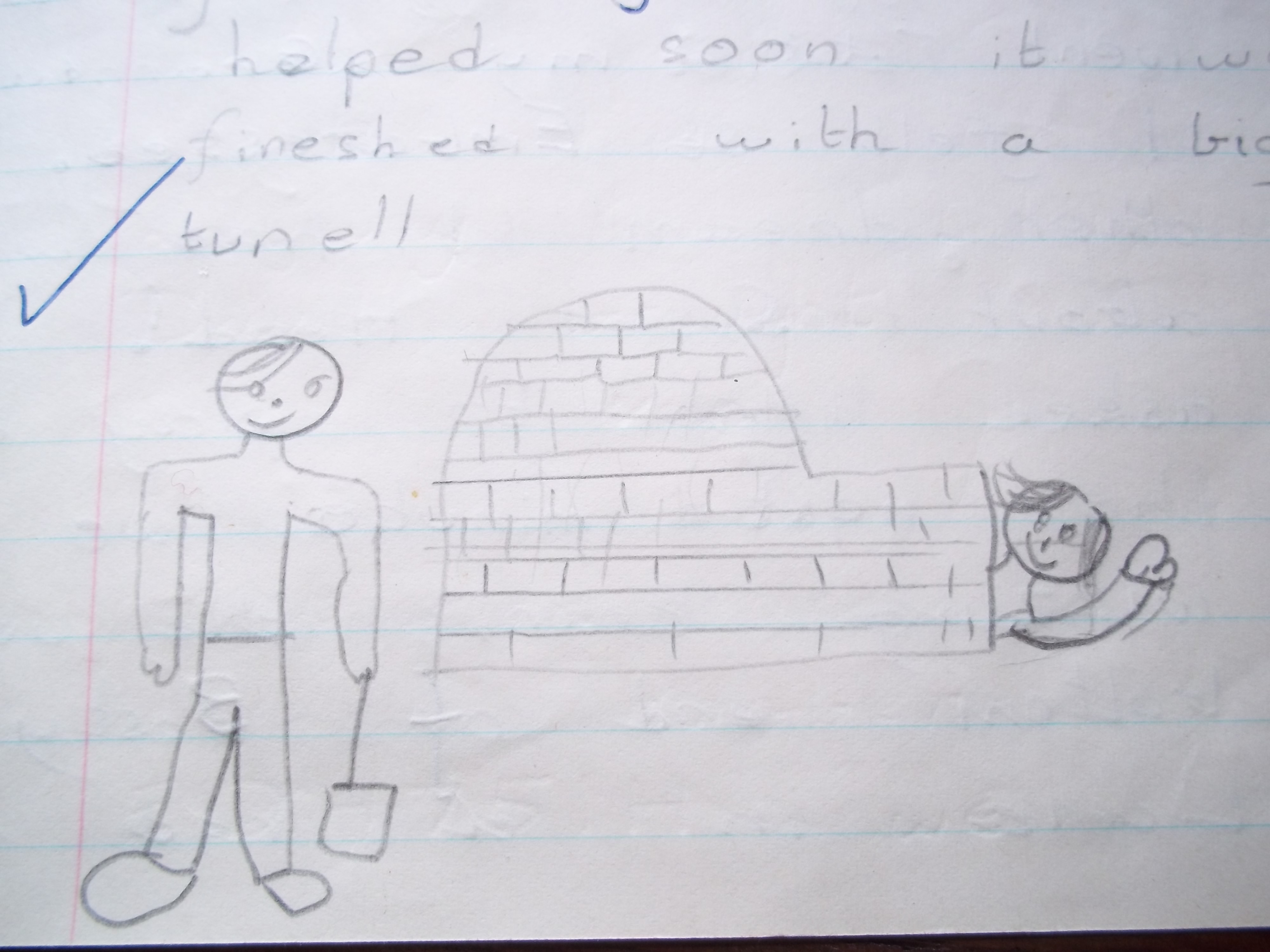
23rd February 1968: ” THE IGLOO! On Sunday my dad said he would help me build an igloo first we had to go to Ikins because my dad had left his wellingtons there when we came back we spent a good two hours on it first of all we made a big wall of snow and when we had done that we started on the bricks we used buckets and we made little castles like at the sea-side then my dad picked them up and put them on top we did this untill diner time then after dinner I called for Geraldine and she helped soon it was fineshed with a big tunell.”100_4611

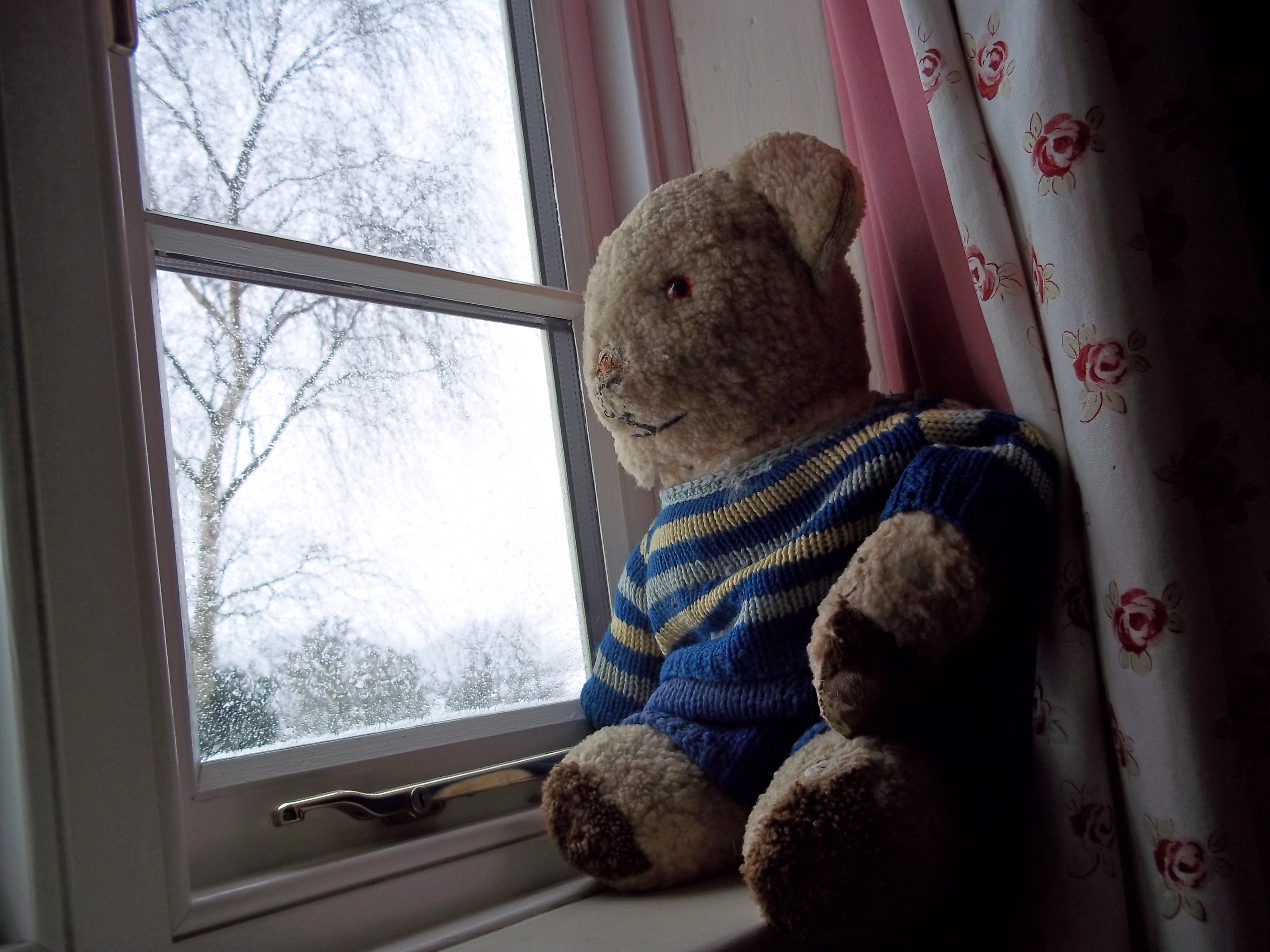
In his threadbare (!) old age, Big Ted is now content to observe the wintry weather from the window. January 2013.
Posted in Uncategorized | 4 Comments

The Name of the Rose

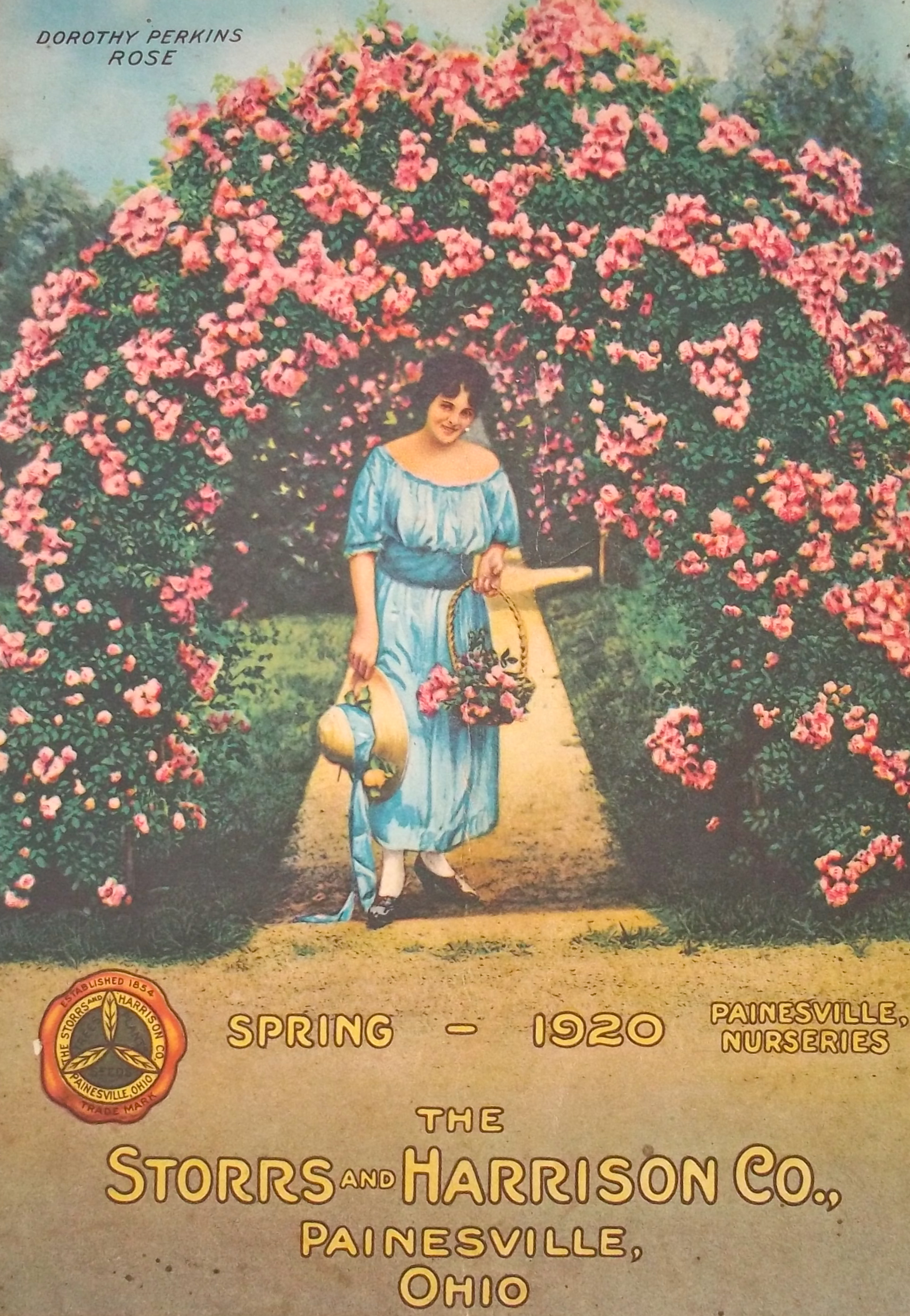
When the rose was more famous than the shop - an American plantsman's catalogue of 1920 from my own collection.

When the rose was more famous than the shop – an American plantsman’s catalogue of 1920 from my own collection.

There are fashions in rose cultivation, just as there are in habits, costume, and coiffure.

A nameless, ancient, pale shell pink rose used to ramble at will all over the old brick barn where my dad’s family lived at Keepers Cottage, Footherly. It had been planted in some distant season without reference to the preferred palette and naturalistic planting schemes popularised by Gertrude Jekyll at the turn of the 20th century, even though it typified them.

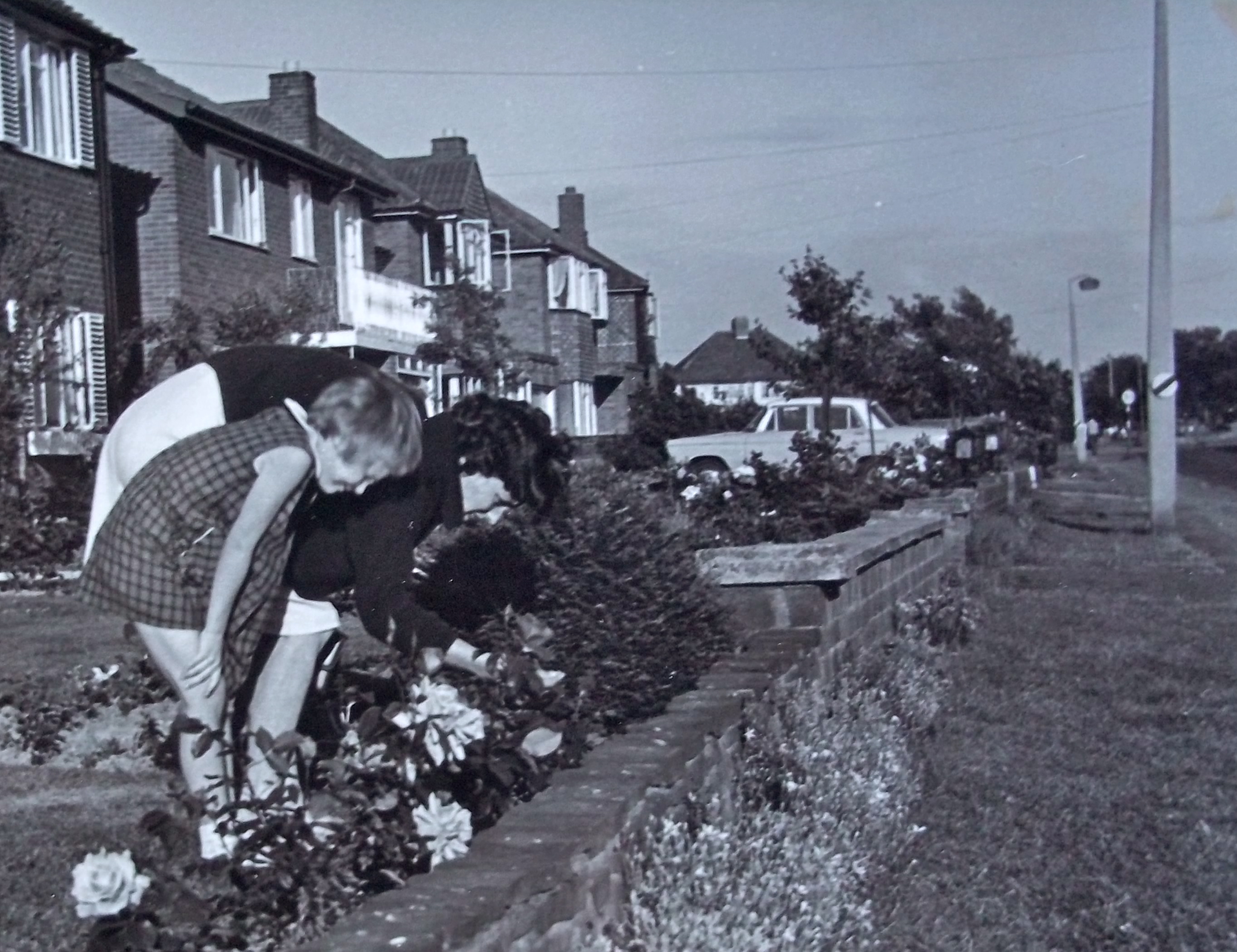
“iceberg,” “Blue Moon,” “Peace,” I could recite the names of all my mother’s roses. At the front of 155, Bosty Lane, Aldridge, in the 1960s.

I was a young child when my mother lovingly stocked our front garden at 155, Bosty Lane, Aldridge with all the latest varieties of “Hybrid Teas”. We really appreciated their virtues: the exquisite form of the bloom, with the classic pointed bud, whose shape endures as the petals around it unfold, and the startlingly intense colours of the latest introductions: “Uncle Walter”, (1963) , a vivid red; “Grandpa Dickson”, (1966), sunny yellow – and “Blue Moon”(1964)- in reality a blueish violet, but even now the nearest approximation of the elusive blue rose.  “Ena Harkness” invited a diminutive Susan to lean in to its ruby flowers to inhale a powerful fragrance, undaunted by the earwigs lurking at the base of the petals.

Hybrid Tea roses are sparse of foliage, and whole beds of them present as a dismal cluster of bare, upright sticks in the winter months, because they sulk if underplanted. These shortcomings mean that are now out of favour with gardening cognoscenti.  All roses, from the wild dog-rose to the florist’s confection give me too much pleasure to criticise them for their faults, unlike Vita Sackville West, who really had it in for a rose called “Dorothy Perkins“. This endearingly bright Barbie-pink rose, a generous bloomer,  she described as an “old enemy”, in her column for “The Observer,” and as  “… a blaze of color; a long, angry, startling streak … I blink on seeing it; and having blinked, I weep.” Oh dear!

The “real” Dorothy Perkins was the grand-daughter of American rose-grower Charles H. Perkins, who named his creation after her back in 1901, fostering a trend for naming roses after people.  The vigorous plant immediately began to win prizes, and become so famous and popular that the H. P. Newman Stores changed their name to “Dorothy Perkins” in 1919.

Nearly 100 years later, the name “Dorothy Perkins” is still emblazoned on shopfronts the length and breadth of Britain. I reckon I would have been about 16 or 17, in the 1970s when I first sloped in to make a purchase of a pretty blouse or some lacy tights in the Dotty P. shop in Park Street, Walsall, but a member of my family had crossed that threshold some 25 years before at a similar age, with much more purposeful a step, let alone far superior deportment and grooming.

My Aunt, Irene Thackeray, nee Sheldon. Born Walsall, 1932.

My Aunt, Irene Thackeray, nee Sheldon. Born Walsall, 1932.

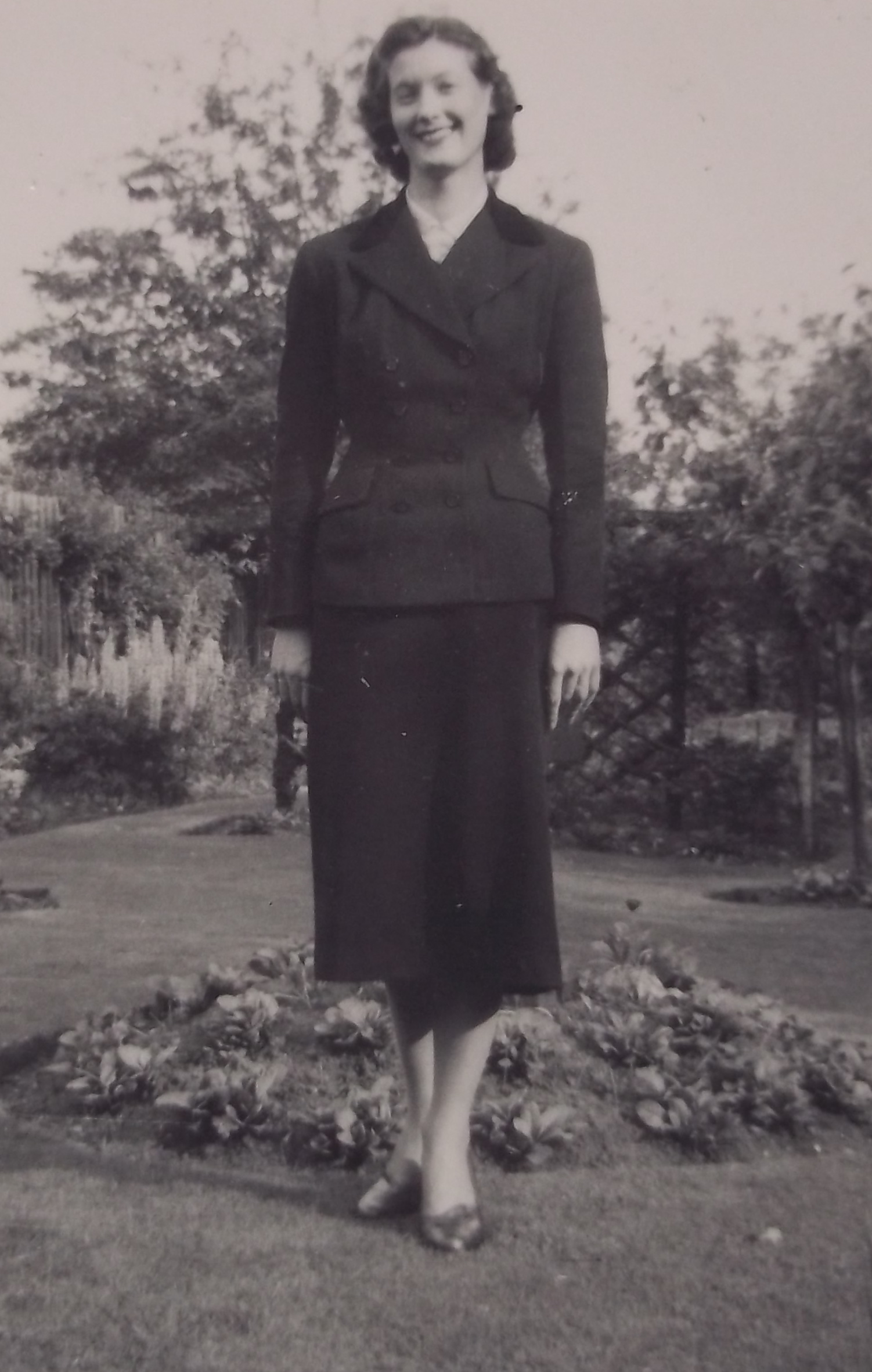
My mother’s next youngest sister, Irene, was a tall, slender, personable girl in a cheap print frock when, she recalls, she was making herself useful by running errands for a near neighbour by the name of Mrs Alice Brown.  Mrs Brown was the manageress of the Walsall branch of Dorothy Perkins, and, despite Irene’s tender years, persuaded her to be recruited into the sales force as a trainee manageress. At first, she was obliged to sport the dreaded greeny-beige button- through uniform of the sales girls – “it was horrible, like a prison dress,” Irene says vehemently.  Soon, in deference to her training she was allowed to wear her own outfit of an impeccably tailored dark suit, and stylish peep-toed court shoes.  She relished the fact that her income enabled her to choose her clothes  for the first time in her life.

The staff of the Walsall branch of Dorothy Perkins in the early 1950s.  A young Irene Sheldon, second row, left, has one hand on the shoulder of Mrs. Rathbone, the cleaner.  Mrs. Brown, manageress, is at the front.

The staff of the Walsall branch of Dorothy Perkins in the early 1950s. A young Irene Sheldon, second row, left, has one hand on the shoulder of Mrs. Rathbone, the cleaner. Mrs. Brown, manageress, is at the front.

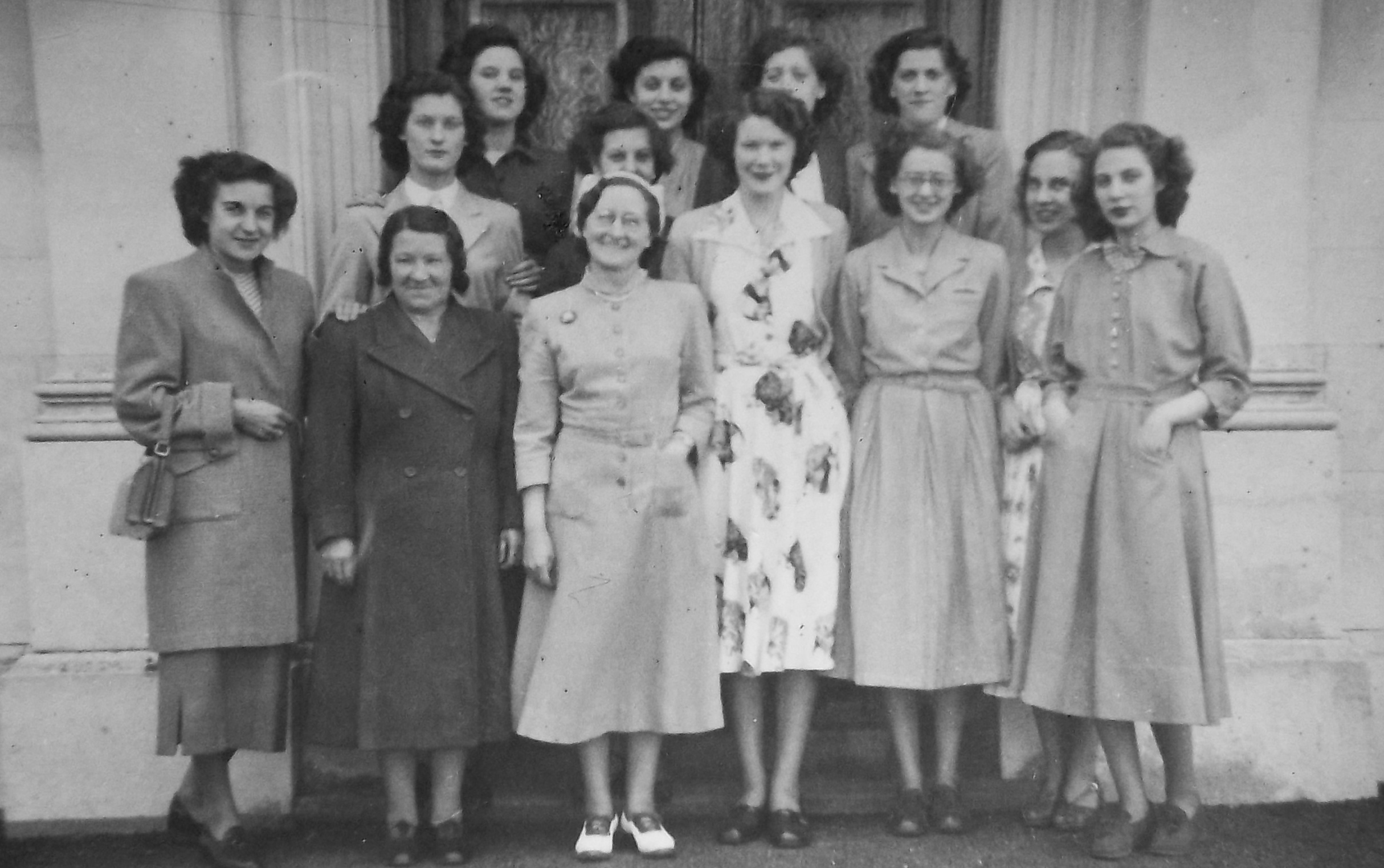
If dainty, now obsolete items of trousseau such as bed-jackets and girdles had been your desire in 1950’s Park Street, you would have been greeted, Madam, at the door of the Dorothy Perkins store by a young lady at once uncannily similar to my mother, but, in Mother’s own words, sweeter and more ladylike. In the role of “First Hand”, the elegant Miss Sheldon would then have shown you to the department you required, be it hosiery, corsetry, blouses, nightwear, or the comprehensive range of knitting yarns which Dorothy Perkins purveyed at the time. Miss Butler, Miss Brazier (whose husband never allowed her to wear make up) or Miss Cooper with their proficient knowledge of the stock behind their own glass counter, would courteously have served you, and neatly hand written the record of your purchase – each ticket being countersigned by the manageress.  A dedicated cashier would have completed the financial transaction. Mrs Rathbone, the cleaner, was an integral member of the team, and appears prominently on group photographs of the staff.  I remember Mrs Rathbone in later life as she lived next door to my grandmother in Bentley.  She was the matriarch of a large family, which, I was uneasily aware, struggled against ill health and poverty.

The Dorothy Perkins girls of Walsall on an outing in the early 50's at an unrecalled location. Trainee manageress Irene Sheldon is centre back, Mrs Rathbone is centre front.

The Dorothy Perkins girls of Walsall on an outing in the early 50’s at an unrecalled location. Trainee manageress Irene Sheldon is centre back, Mrs Rathbone is centre front.

When a relief manager was required at West Bromwich, the company had an opportunity to assess Irene’s ability to run a shop.  Acquitting herself well, and not quite nineteen years old, she was offered the position of manageress of the Worcester branch.  Reassured that The Church was able to find a respectable Catholic family for her to board with, my grandfather gave his permission for her to go.

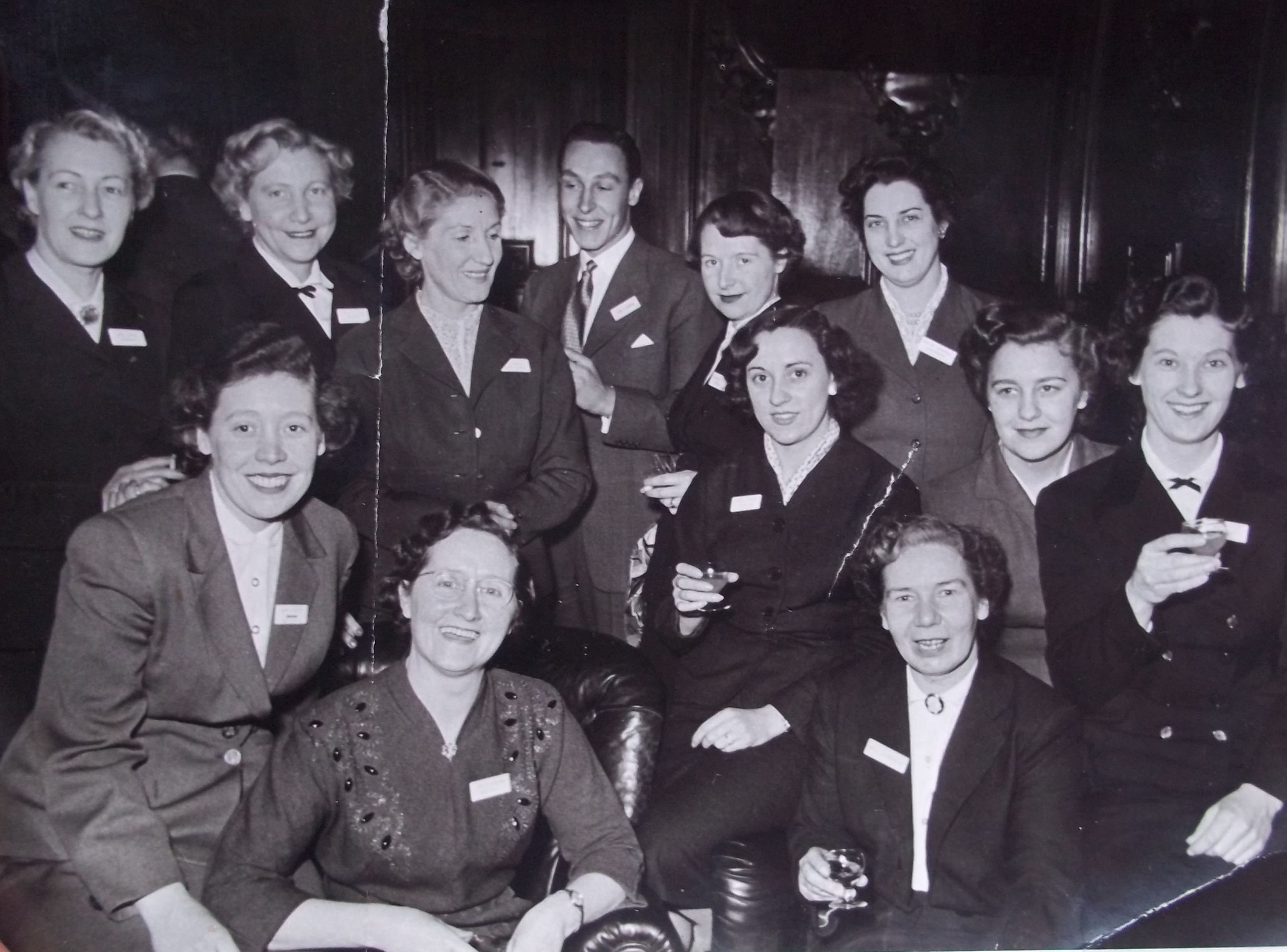
Mr Farmer, a member of the family which owned the company, made regular visits to the larger stores, including Worcester.  He was also present (and it looks like it is a terrible chore for him)  at a conference attended by Dorothy Perkins manageresses and area supervisors from far and wide. Worcester seemed cosmopolitan to Irene after Walsall, but arriving by train in London she feared to leave her hotel at all, in case she got lost in the streets of the capital.  A coach arrived at the hotel in the morning to transport the delegates to the impressive Ashridge conference centre in Hertfordshire.

Irene Sheldon, right, attended a conference for managers in the Dorothy Perkins organisation at Ashridge in Hertfordshire.  Mr Farmer is the thorn amongst the roses.  Mrs Brown, front left, and area manager Miss Marriot is front right,

Irene Sheldon, right, manager of Worcester branch, attended a conference for managers in the Dorothy Perkins organisation at Ashridge in Hertfordshire. Mr Farmer is the thorn amongst the roses. Mrs Brown, the manager at Walsall branch is front left, and area manager Miss Marriot is front right,

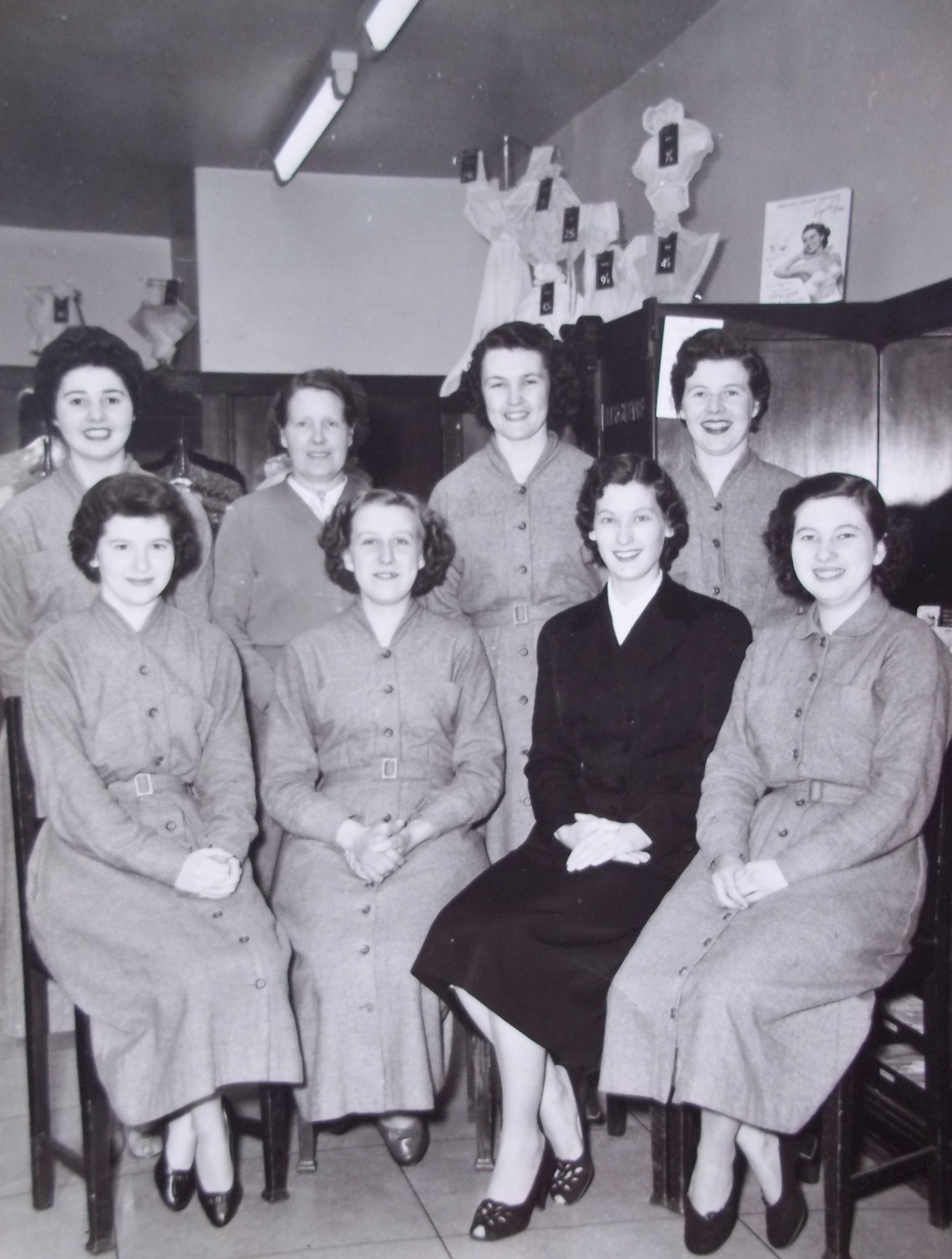
The Worcester branch of Dorothy Perkins, managed by Irene Sheldon, photographed for the company magazine.

The Worcester branch of Dorothy Perkins, managed by Irene Sheldon, photographed for the company magazine.

Irene thrived at Worcester. Her salary of £30 per month enabled a single girl to live well and to save for the future.  She became great friends with all the girls who worked for her, including Miss O’Connell, Miss Thatcher, and Worcester branch’s cleaning lady Mrs Turbeville.  This lovely shot of the staff in their shop was taken for the Dorothy Perkins company magazine. The young photographer who took the picture returned to the shop several times, for what he insisted were vital retakes. He had, Irene remembers with amusement, “The biggest ears you ever did see.” Eventually, he plucked up courage to ask Irene to go out with him.  But an evening at the Wolverhampton Grand Theatre, and afternoon tea with his parents in their Worcester flat were insufficient to impress. On New Year’s Eve 1954, Irene was to meet her future husband, at the exclusive staff ball held at the Powick Asylum. As midnight chimed, a net of balloons was released from the splendid ceiling of the Victorian ballroom. Irene watched a girl sip from a glass of port as she sternly warned a defiantly grinning young farmer in a sparkling white dress shirt to desist from popping the balloons with his lighted cigarette.  He earned a big sticky red stain for the front of his shirt from that other girl’s glass of port wine.  Despite that, Irene accepted a lift home on the back of Trevor Thackeray’s motorbike……………….and…..and

Then this happened..but Irene's career at Dorothy Perkns continued, and Miss Marriot suggested further promotion...

Then this happened..but Irene’s career at Dorothy Perkns continued, and Miss Marriot suggested further promotion…

.....but then this started happening as well.

…..but then this started happening as well.

Posted in Uncategorized | 24 Comments

Queen, Countess, and Paupers.

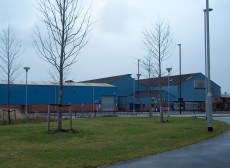
100_4455The Guardians’ Building is the only remnant of the Walsall Union workhouse, whose infirmary evolved into the adjacent Walsall Manor Hospital.  In its early Victorian, Italianate splendour, it is something to admire, whilst waiting on the car park for festive visiting hours to begin on Ward 9 – perhaps, noting the leafy growth from the roof, while I still may.

Respecting the season,  car parking charges have been waived during the 25th and 26th of December, which I find an incongruous gesture. Mother seems quite gleeful, as if this were a Christmas gift, or that we were getting away with something we oughtn’t to. Despite the iron grey skies, and our anxious sympathy for the patient we have come to spend time with, these visits are definitely not the darker interludes of the 2012 holidays. There is sporadic cheerful chatter between the two of us and it is my delight to be free of a hostess’s teeth-gritting obligation to make meaningless small talk with people you are forbidden from disliking. My mother’s youngest sister, although confined to bed, tetchy and in pain, has got some colour back in her cheeks, and we are optimistic about her chances of recovery.  The car park is large and level, and although we are looking through leafless trees onto industrial premises, their careful planting amongst grass and shrubbery gives the impression that the environment around the building has been considered important.  I do hope the suitably empowered realise the uplifting potential of preserving the Guardians’ Building.

We have been in and out of here too frequently in the last few years, and remember the mud and pot-holes we used to struggle to park up in: an extra flake of irritation in 2007 –  tiny, beside the gigantic gouge of loss we were experiencing.

100_4461

The new Manor Hospital. Does the architecture of the new hospital make a faint nod towards the style of the Guardian’s Building?

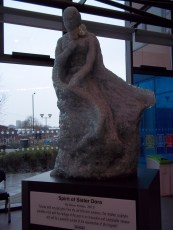
Now, the redeveloped hospital is bright and impressive, with lofty halls, light-filled corridors and a reassuring emphasis on cleanliness. We used to associate our local nursing heroine, Sister Dora, with the old General Hospital, but now she is commemorated here at “The Manor.” There is a prominent board bearing information about her life and significant contribution to nursing, and a plaster cast model of her strong, noble features, identical to the bronze statue by FJ Williamson on The Bridge, which has been familiar to me for the whole of my life.

100_4463

“The Spirit of Sister Dora”

Just inside the entrance, The “Spirit of Sister Dora” is a 2010 work by Steve Yeates, which, very appealingly, has been created from glass from the windows in the old infirmary.  There is something very fitting and moving about the sculptor metaphorically capturing the troubled stares of the sick paupers of long ago through those old panes, from their sick beds to the busy world outside, and incorporating them into this lovely work of art.

As the wintery minutes ticked on until two o’clock, me and Mom gazed, in companionable silence, across Pleck Road, through the rain beaded windscreen of the silver Ford Fiesta, my late dad’s final car, which I inherited, I calculated, five and three-quarter years ago, the day he didn’t come back out of The Manor Hospital. Ghosts tend to rise at Christmas.

100_4447

The site where my great-aunt Louisa’s house stood in the first half of the 20th century.

“My Aunt Lou used to live over there, just where that blue building ends,” my mother said, unexpectedly.  My mother’s memories stretch back to 1930’s Walsall, but supposing that my great-aunt, Cecilia Louisa Ruddell, nee Sheldon, had moved to the little house in Pleck Road early in her marriage to Uncle Ted?

100_4449

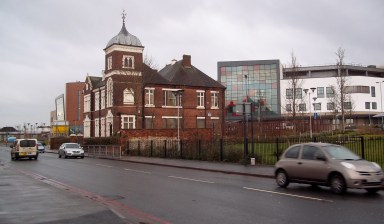
View of the Guardians’ Building from the site of Louisa’s house. The Union workhouse buildings stood where grass and trees have been planted.


It would have been business as usual in the Union workhouse in those days, and how must it have felt to peep round the lace curtain in the tiny parlour to see a downcast queue shuffling in the cold immediately opposite, outside the Receiving Ward? Was it a sight so commonplace that it did not merit notice?  Did my great-aunt, with her industrious husband, and manageably sized family of three, view the inmates as feckless and lacking in pride?  Or did she clutch little John, Eileen, and Kathleen to her skirts, and remember with a shudder that she had been told that her own great grandparents had ended their days in the a Union workhouse?

The Sheldon family in the 18th and 19th centuries populated the area in and around Ocker Bank, the very heart of the Black Country.  My great grandfather and his Irish wife migrated slowly eastwards, first to Wednesbury, where my grandfather and his sister, great-aunt Lou, were born in the 1890’s, and by 1911 they were living at 196, Queen Street, Walsall.  This is a house my mother remembers well.  Steps up to the front door, parlour, living room and scullery.  Mom’s grandmother, born Maria Egan, spoke with a strong Irish brogue.  Her white hair was piled up on her head in a bun, and over her long black dress she wore a sparkling white pinafore.  She would stride from the back door, past the outside lavatory and shed, over a small thoroughfare to the garden, where she kept her chickens. Her fierce devotion  to the faith she was brought up in reverberates down the years.  There was no question that her son Edward, my grandfather, would have all his five children brought up as Romans Catholics.  His youngest daughter, my currently hospitalised aunty,  remained both unmarried and devout.  She has had a long career of unpaid service in the church, and “Fathers,” and “Sisters” may both be encountered at her bedside at visiting time.

A little way down the road from the Sheldons in 1911, census returns reveal 185, Queen Street to be the home of the Ruddell family, including great-aunt Louisa’s future husband.  His occupation, like that of my grandfather at the time, is described as “Caster’s helper.” Was the man Louisa married her brother’s foundry workmate, as well as her neighbour? Meanwhile, 18 year old Louisa works as a “Jappaner of Harness Furniture”, a typical Walsall occupation in the “Town of 100 Trades.”

My grandparents’ first child was born in the family home in Queen Street, but by the time my mother came along they had moved out into rooms in Countess Street.  In Deepmore Avenue, Bentley, their address lost its aristocratic connotations, but a spacious, new, council house was theirs, where three more children arrived.

At the bottom of Queen Street is the small cemetery, now overgrown, where Dorothy Pattison, “Sister Dora”, was laid to rest in some grandeur following her death on Christmas Eve 1878.

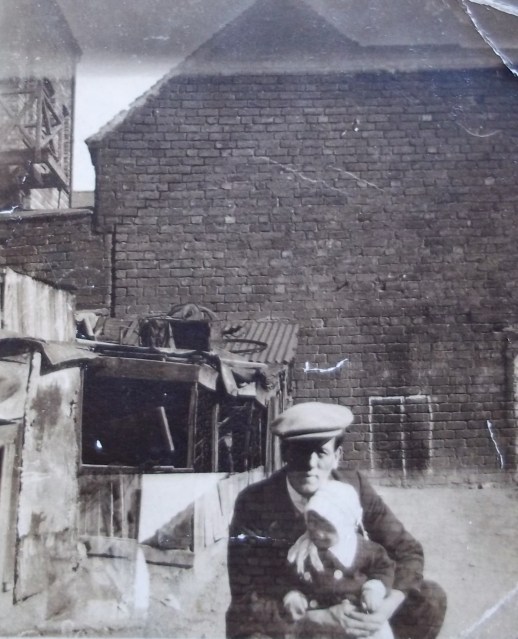
100_4511

My maternal grandfather, Edward Sheldon, in about 1927, with his first child, Winifred. At the rear of the house in Queen Street, Walsall

Posted in Uncategorized | 7 Comments

Getting tears from a stone

I felt that I had mildly special reasons to be excited about Terry Herbert’s discovery of The Staffordshire Hoard on Fred Johnson’s land in the summer of 2009. It fired my imagination to think that numbers of my family might well have crossed those very fields for generations, oblivious to the glowing garnet and gold treasure beneath the stride of their working boots.

And all that talk of shields and sword pommels adorned with cloisonne and filigree brought back memories of hedonistic, full grant, London University days.

It was during the spring of 1983 that I made a futile attempt to compensate for my dedicated and thoroughly reprehensible time-wasting during the preceding 27 months. The core of the course was English Literature, up to 1880. For my “special subject”, inspired by mesmerising fragments of Anglo Saxon poetry, I made the maverick choice of Anglo Saxon Archaeology. The course was conducted in Bloomsbury, necessitating a weekly, teatime, bicycle-train-bicycle dash from my campus in leafy Surrey.

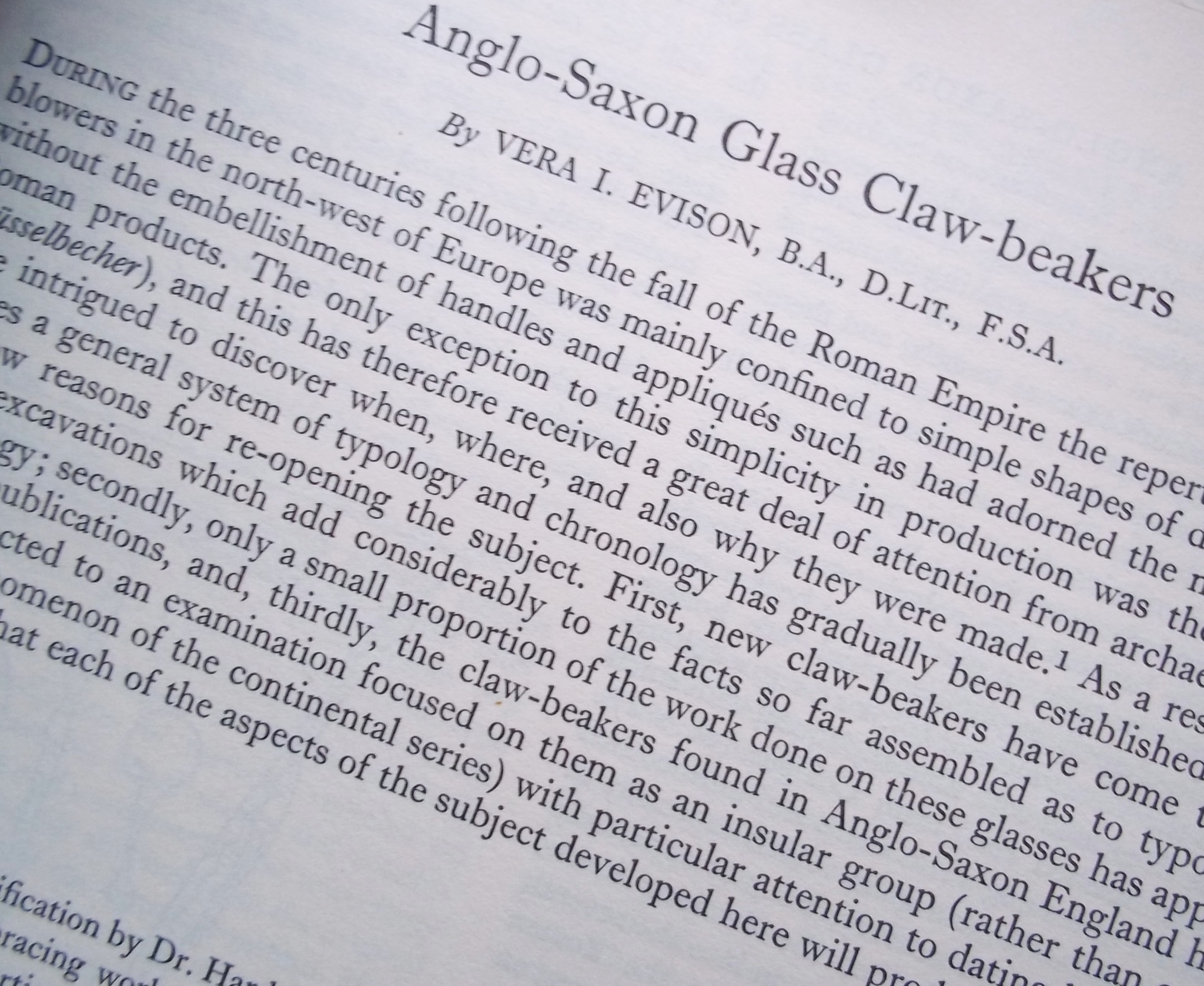
20121208-163340.jpgI was an indolent and distracted student, but it was well worth the effort of the journey to listen to Vera Evison, who illustrated her lectures with grainy slide projections. These showed a still recognisable Miss Evison, all tweed skirts and brown brogues, offering up to the camera some small but significant bits of glass and metal from the depths of a sepia tinted trench in the 1920s and 30s.

I was entranced by the experience, deeply impressed by the outfits, and fascinated by archaeology, but had hardly taken in any facts.

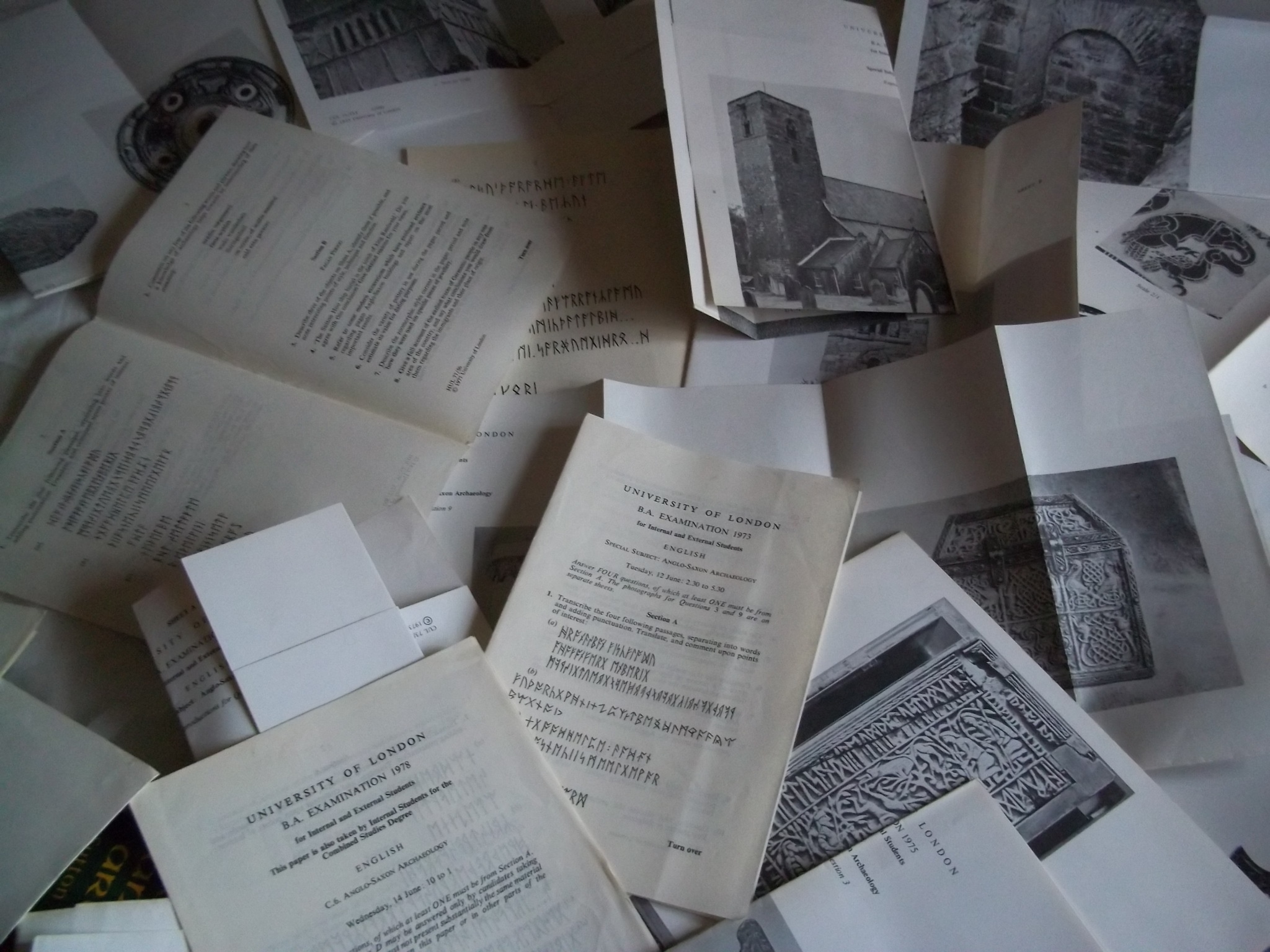
Fortified by pork pie, and swilling Courage Directors’, I scoured past exam papers for hints and clues and cheats which might, hope beyond hope, assist me in my finals. The Anglo Saxon examination was to include a “picture round” detailed on a large, glossy, black and white, pull-out page.

20121208-163428.jpgArtifacts from the Sutton Hoo ship burial, excavated in 1939, predominate on the 1970s papers.

A few Saxon church towers, and the unprepossessingly rusty looking “Benty Grange Helmet”, found way back in the 19th century, appear repeatedly.

Each year a different one of the five decorated faces of the “Franks’ Casket” was given an outing. The inscriptions on that were also a handy resource for those setting tests in runic translation. The casket was made around the 8th century out of whale bone, but was cavalierly being used by a French household as a sewing box until shortly before Augustus Wollaston Franks bought most of its sorry remains in a Parisian antique shop in 1857. They were all old news, these finds, and not very numerous. But that was before what we like to call The Brownhills Hoard. Setting exam questions must be much more interesting these days.

You really can’t imagine how all that lustrous gold, thrust roughly into the ground near the Watling Street escaped notice for so long, especially now that we know that the hoard was scattered by ploughing activity. Once “detected” and dug up, though, it would have been impossible not to notice that you were holding precious things in your hands.

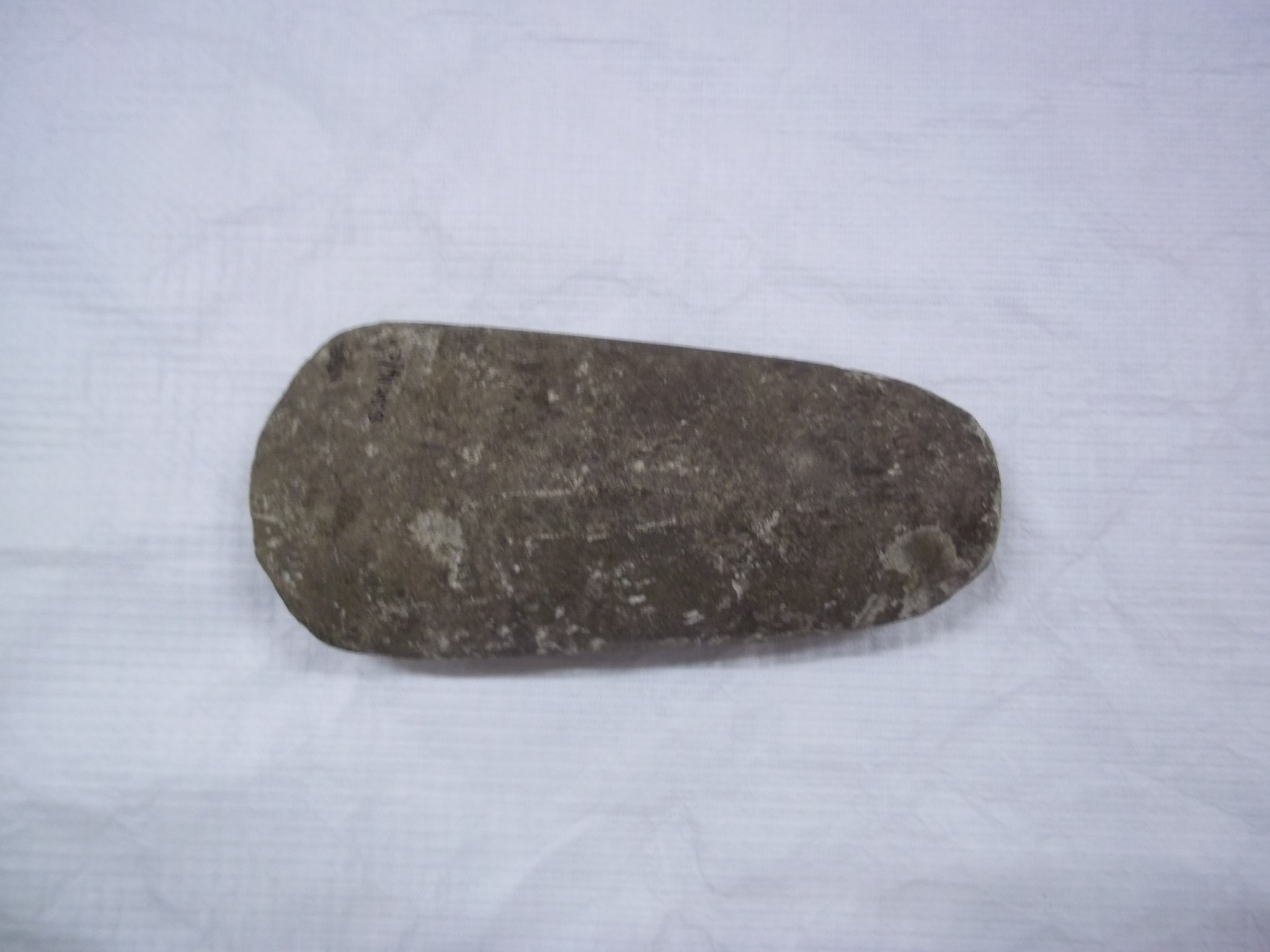
So, I think that huge credit should be given to a young girl who, in 1954 Lynn, in the “Big Field” of Owletts Hall Farm, noticed a smooth, dull, stone protruding from a post-hole which she had been digging to position a horse-jump, and instantly recognised it as an archaeological find. Lichfield Museum Services were less than interested, but the “Friary” schoolgirl was happy to exchange it for a fat Postal Order from Birmingham Museum. According to “Discovering Stonnall”, produced by the Lynn and Stonnall Conservation and Historical Society, my cousin Rosalind had discovered the only Neolithic axe that has so far come to light in the parish of Stonnall. This is a little disingenuous of them, since, when I paid Ros’s axe a visit recently at the Museum’s fantastic storage facility, it was nestling companionably in a drawer with some other Neolithic axes from very closely adjacent Shenstone. These were finds by Mr Charles Foden who, luckily for we interested parties, made a habit of following his ploughman to see what might turn up on the land of Shenstone Hall Farm. He made donations to Roman as well as prehistoric collections.

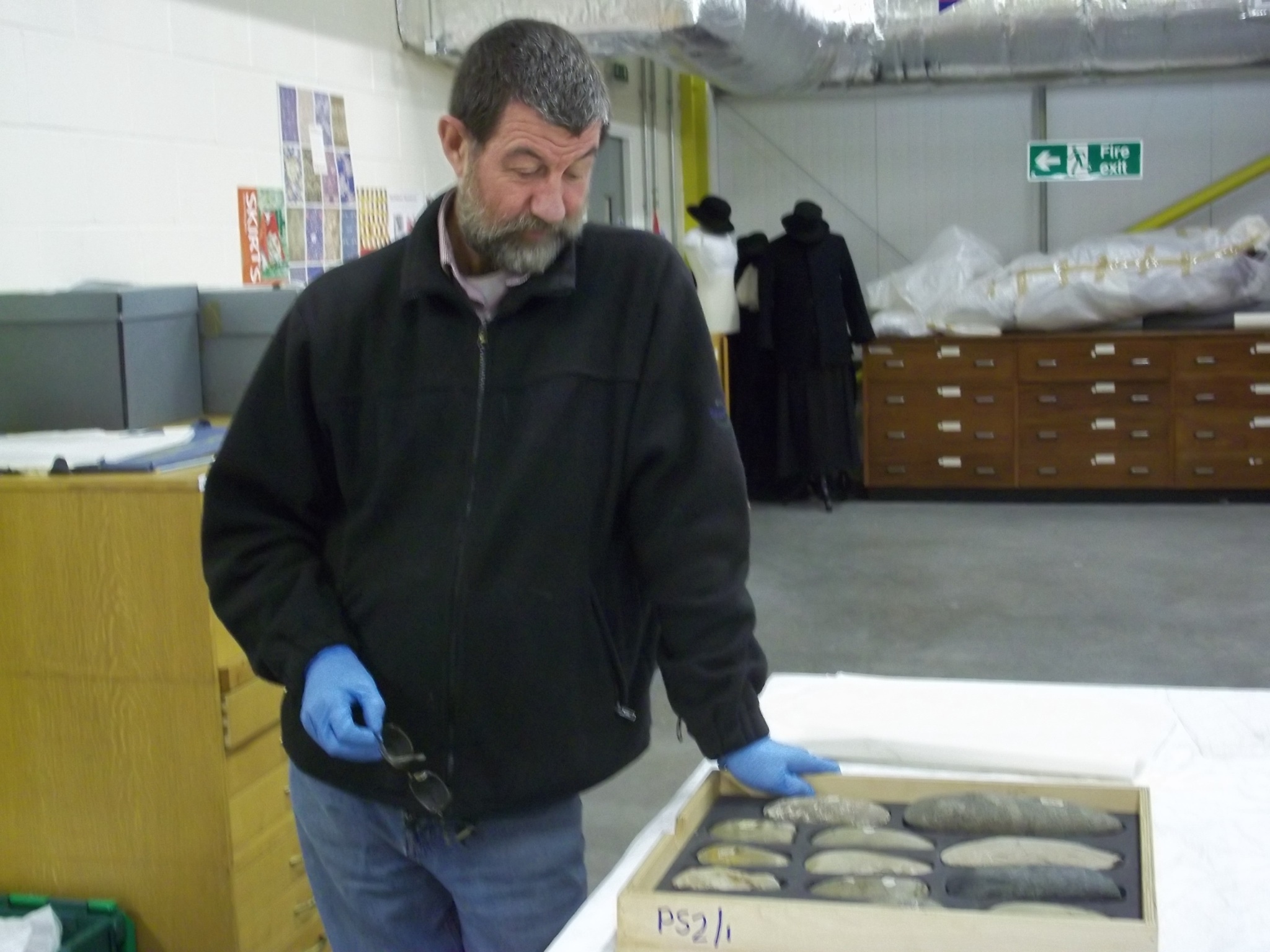
We pulled up at Birmingham Museums’ secret, extra building on a bright winter’s morning. We have been in a fair few warehouses over the years, foodstuffs, car parts, workaday and boring. This visit, however, was an unforgettable and surprisingly emotional experience, following Collections Manager, Phil Watson through the serried rows of archived exhibits, to the drawer which holds our axe. Ken and I made slow progress down the aisles, looking from from side to side and back again, in something approaching awe. A Dali-esque array of ships’ figureheads, perambulators, engines, stuffed birds and framed embroideries seemed to be bursting forth from the racking, but, within some arcane cataloguing system, all was in absolutely perfect order, and solicitously protected by fire suppression systems and parasite traps. Phil Watson allowed himself a wry smile at the looks on our faces – he says he is quite used to visitors to this establishment being quite overwhelmed by it.

20121208-163057.jpgHere is the object. An axe. A tool for felling trees. Ken has a fearsome collection of metal bladed axes at home – weapons used daily in the constant battle to feed our greedy Rayburn. He could only imagine this stone axe wielded day-long until it achieved the pulverisation of bark and wood. Not what you would describe as “cutting”. But without recourse to metal tools, this beautiful object would achieve exponentially more than bare hands. The stone is from Charnwood Forest, I learned. This tangible evidence now enables me to contemplate our ancestors – many, many generations ago in what is now called Staffordshire, trading stone along an ancient track, shaping and polishing stone with a high degree of skill, and clearing the deeply forested land to farm it for food.  I admired another object in the drawer: mossy-green, mottled, highly polished, right beside the Owletts Axe. Within such a small sample, it was startling to see that the location of its discovery was Orgreave, where we live. Its asymmetrical appearance is due to its sharp edge having been repolished following use. Phil Watson had showed us larger scale examples of these tools which would have been impractical in use, had not been worn, and could be surmised to be ceremonial objects, serving as status symbols, or even currency. He took us to a nearby cabinet, and removed a knapped flint tool over a hundred times older than than the others. This, I was allowed to hold. Ergonomic is the word. My hand folded around it, an exact fit. My thumb found a perfectly placed depression to assist me to grasp it.  Objects with the patina of 50 years handling can excite me.  To touch this 500,000 year old object was overwhelming.  There were tears!

20121208-163257.jpg

The excellent Phil Watson, with a drawer full of Neolithic Axes found in Staffordshire

Posted in Uncategorized | 9 Comments

Went to Wyrley, started early.

Ron and Betty Mowday, their dog Bunty, and Mother with her "Italian Boy Haircut"

Ron and Betty Mowday, Bunty their dog, and Mother with her “Italian Boy Haircut”.
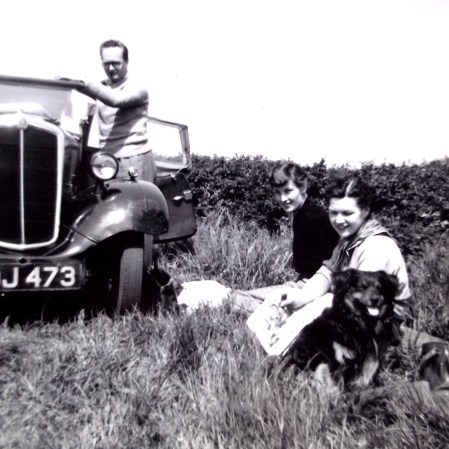
Taken in the 50’s, adjacent to a now abandoned stretch of the Wyrley and Essington canal, near Lichfield.

Fairbourne is a small Welsh seaside town boasting an attractive two-mile stretch of golden sand and a Victorian miniature railway, and a not-very-Welsh name. Much like Westward Ho! in North Devon, the resort was superimposed on a quiet rural community during the 1860’s: in Fairbourne’s case, by the flour magnate Sir Arthur McDougal, upon a settlement originally called Morfa Henddol.

Mr and Mrs Booth’s commodious bungalow in Fairbourne provided several letting rooms for holiday-makers, and my parents were one of the young couples enjoying Mrs Booth’s bustling, motherly hospitality, bright and breezy hikes, and terrifying (according to Mom) ferry trips across the bay to Barmouth one year in the early 50’s.

Billeted in one of the other rooms were Ron and Betty Mowday from Birmingham.  Ron was a bit older, and had seen active service at Montecassino.  My dad had enjoyed his time in the First Battalion of the Welsh Guards, and was posted to the Middle East towards the end of the conflict. As is often the case with ex-servicemen, an easy camaraderie grew up between the two men, and the couples shared a wicked sense of humour and continued to socialise with each other when they returned to the Midlands after their holidays.
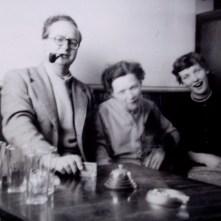
Ron, Betty, and Mom, acting daft for my dad's camera in the "Duke of Wellington" pub on the Birmingham Road, Lichfield.  1950's

Ron, Betty, and Mom, acting daft for my dad’s camera in the “Duke of Wellington” pub on the Birmingham Road, Lichfield. 1950’s.

Ron didn’t drive, and weekend jaunts angling or walking were taken in “Old Bodge”, my dad’s 1935 Morris Eight tourer, registration number BOJ 473. When Betty and Ron moved from their flat at the top of a Victorian mansion in Handsworth to their own little place in Wharwell Lane, Landywood, the interesting old house known as Little Wyrley Hall was only a short distance away, and an ideal venue for an outing. My mother remembers a shocking quantity of animals’ heads gazing down glassy-eyed at her from the walls of a majestic beamed hall that afternoon….but little else. Which is a shame, because following a super evening in the Methodist Church Hall in Brownhills recently, listening to the knowledgeable and entertaining local historian Gerald Reece, I have a special interest in the old house, fascinating in its own right, which was home to the movers and shakers in the early history of mining in the Brownhills area.

Never mind – I retrieved one of my boxes, and blew on the top, raising dust like a puff of magic powder, because inside was a copy of Country Life nearly contemporary with my parents’ day out in “Old Bodge”, containing an illustrated article which describes the hall, and some of contents and occupants, in as much detail as anyone could wish for……

    LITTLE WYRLEY HALL, STAFFORDSHIRE

The Home of Mr and Mrs Frank Wallace. By Gordon Nares. (from “Country Life” magazine, 1952)

To the Tudor, Carolean, and William-and-Mary nucleus of his forbears’ house Phineas Hussey made numerous alterations about 1822, when he was High Sheriff of Staffordshire.

Many a country house, and often the most endearing, possesses character not because it is an unaltered example of a definite style or period, but because it has been built piecemeal at different times, wing by wing, or even room by room, as the size, wealth or ambition of the owner’s family increased. When such a house has been in the possession of one family for many generations and has been filled with the accumulated possession of one family of centuries – and Little Wyrley Hall is as good an example as any – it achieves a degree of liveableness that is the antithesis of the famous lines:

I find by all you have been telling
That tis a house, but not a dwelling.

The manor of Little Wyrley, which lies just to the south of the Watling Street mid-way between Lichfield and Wolverhampton, has belonged to the same family since the reign of Queen Elizabeth, descending in the female line through the Fowkes and the Husseys to the present owner, Mrs. Wallace. The Fowkes’ predecessors, either the Blunts or the Levesons, built the Tudor core of the house.

Soon after the Restoration of Charles II, Ferrers Fowke and his wife cased this old half-timbered building in red brick and enlarged it considerably, while at the same time they built the near-by farm buildings. In 1691 Dr Phineas Fowke added the rooms on the east side of the house. The house then remained unaltered until the end of the Napoleanic Wars, after which Phineas Hussey made various additions, notably to the interior. There is thus work of four periods embodied in the house. Of these the most prominent are the two middle ones, for most of the exterior and much of the interior was built in the late 17th century by Ferrers and Phineas Fowkes..
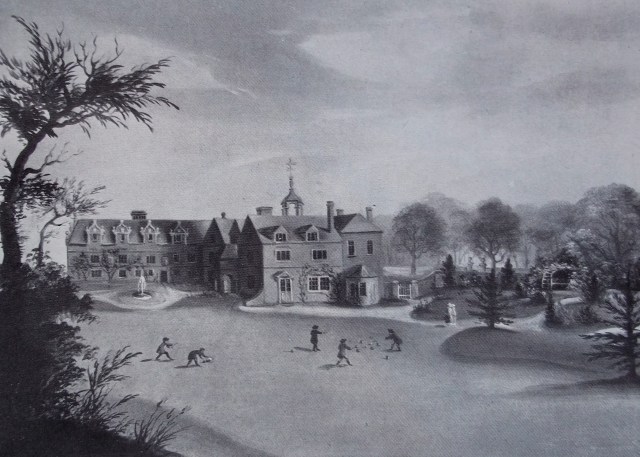
LITTLE WYRLEY HALL BEFORE PHINEAS HUSSEY'S ALTERATIONS.  AN OIL PAINTING OF ABOUT 1790

LITTLE WYRLEY HALL BEFORE PHINEAS HUSSEY’S ALTERATIONS. AN OIL PAINTING OF ABOUT 1790

Little Wyrley Hall can be seen much as they left it in an attractive little oil painting dating from about 1790, which hangs over the fireplace in the library. This view, from the south, shows Ferrers Fowke’s kitchen and brew-house wing on the left and the refaced nucleus of the house in the middle; the junction between the old part of the house and Phineas Fowke’s east wing can be clearly seen on the right hand side of the painting. The main block is shown with its original casement windows and without finials to the gables. The existing finials, hich are such a picturesque feature of the elevation, were copied from those of the Catolean brew-house dormers and were added by Phineas Hussey, who also substituted sash windows for many of the casements. Prominent in the painting are what the Rev Stebbing Shaw in his “Staffordshire” (1801) calls the “phalanx of elms and other large trees” – which stand to the north and east of the house and earned it the name of Wyrley Grove until 1928 – and also the charming cupola, which unfortunately had to be taken down in 1914.
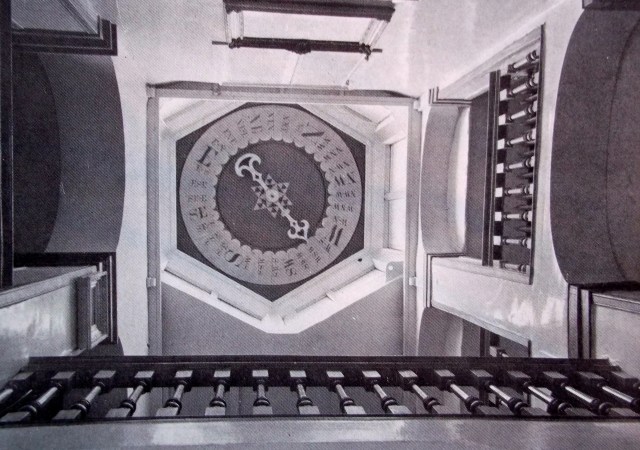
THE WIND INDICATOR SURMOUNTING THE STAIRWELL

THE WIND INDICATOR SURMOUNTING THE STAIRWELL

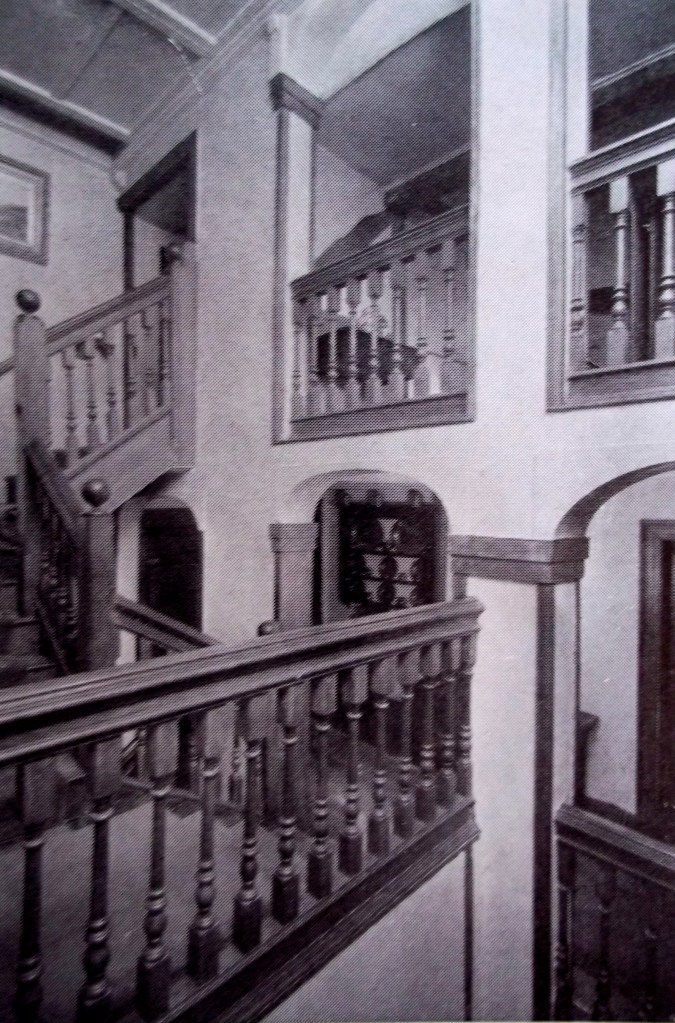
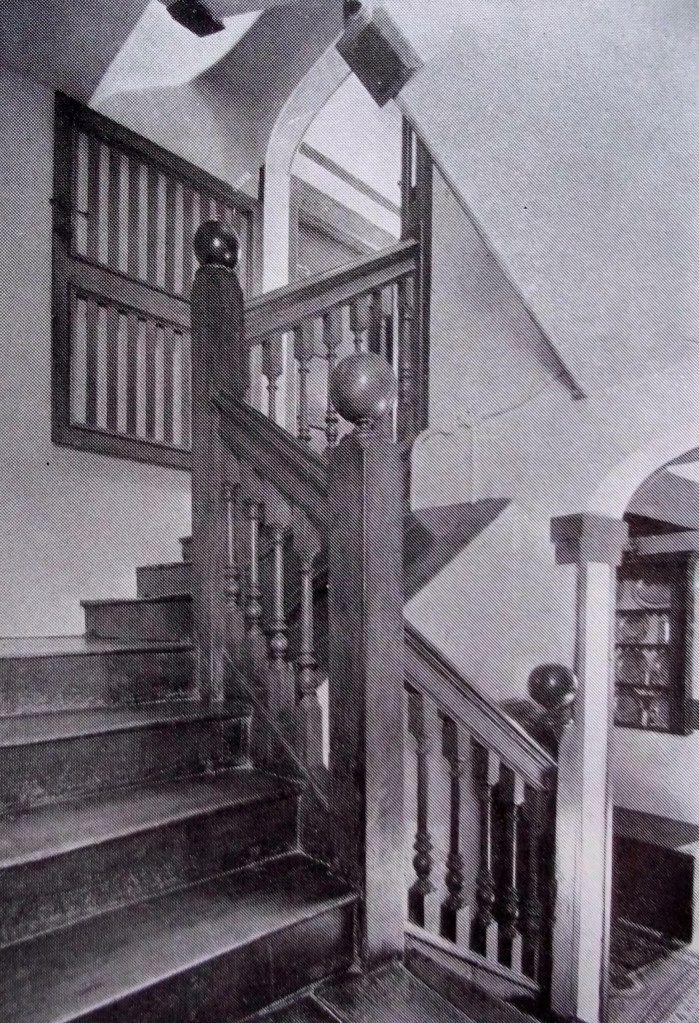
The cupola originally surmounted Ferrers Fowke’s staircase, and its hexagonal wind-indicator can still be seen in position. The staircase is situated in the south-east corner of the entrance hall, which is probably the hall of the Tudor house and lies immediately inside the porch. The space in which the stairs make their ascent is more restricted than appears at first sight, for, although the stairwell has three bays, one of them is open to allow an uninterrupted view from the ground floor to the wind-indicator on the roof. In the other two bays the stairs make their tortuous journey from the ground to the second floor, providing at each landing and half-landing different views of steep mounting steps, sturdy newels, simple turned balusters and arcades. Despite the economy of space and materials, this staircase provides a remarkable visual effect by comparison with others of about the same size and date.
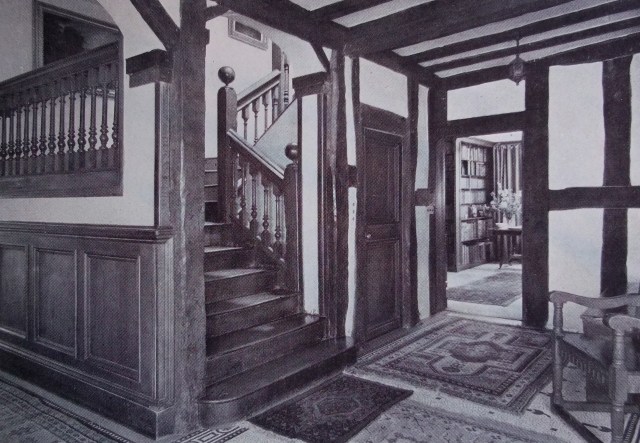
THE FOOT OF THE CAROLEAN STAIRCASE IN THE SOUTH EAST CORNER OF THE HALL
THE FOOT OF THE CAROLEAN STAIRCASE IN THE SOUTH EAST CORNER OF THE HALL

100_4363

FROM THE GROUND TO THE FIRST FLOOR

100_4364

THE UPPER PART OF THE STAIRCASE

Opening off the hall at the foot of the staircase is the library, which occupies the south-west corner of the house and was formed by Phineas Hussey early in the 19th century. It seems likely that there were two rooms here before Mr Hussey began his alterations and that he made on large room out of them by driving a wide opening in the parti-wall. Some of the old ceiling beams were retained, but all the windows were altered and the walls were clothed from floor to cornice with bookshelves, which display the fine collection of leather-bound volumes collected by Phineas Hussey and his literary great-great uncle, Dr Phineas Fowke. Even the back of the door from the hall is panelled with dummy books. A door opens intot he smaller of the library’s two bays. Facing is a window, and on the left is the door into the drawing –room. On the right is the book-lined opening which joins the two parts of the library and which frames the view looking west towards Phineas Hussey’s bay window – a charming piece of Regency design with slender Gothick sashbars and a hand painted floral border in deep orange and sienna.
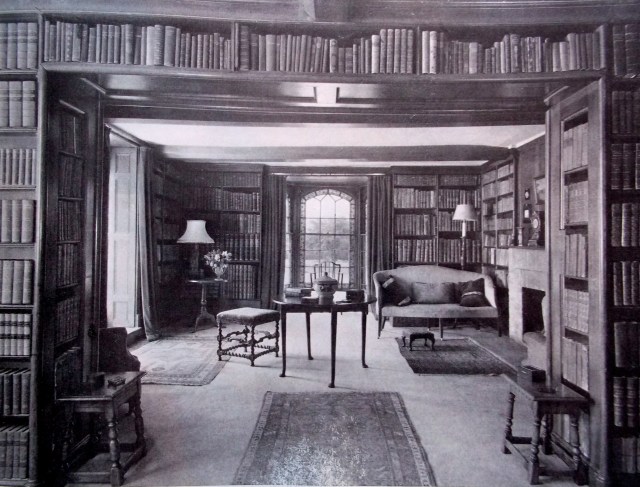
THE LIBRARY FORMED BY PHINEAS HUSSEY ABOUT 1822

THE LIBRARY FORMED BY PHINEAS HUSSEY ABOUT 1822

The scene of Phineas Hussey’s other principal contribution to the re-decoration of Little Wyrley is the dining room, occupying the north-east corner of the house on the ground floor of Dr Phineas Fowke’s east side. Doubtless it was once panelled with fat bolection mouldings, like the rooms on the first floor on this side of the house, but as it stands to-day it is a good example of plain late Regency taste, complemented by solid Victorian furniture. The ceiling is divided by a number of sparingly moulded transverse beams, which give it a coffered effect. The north wall is slightly bowed, with a central window (since removed) and flanking niches. The windows on the long east wall, containing the coloured heraldic glass, have red velvet curtain, and the walls are pale green. The central window originally held a further fine example of this heraldic glass, but unfortunately, when Little Wyrley was let to a family of local ironfounders after Phineas Hussey’s death, certain guests drank too much wine at dinner one night and hurled the empty bottles through the window.
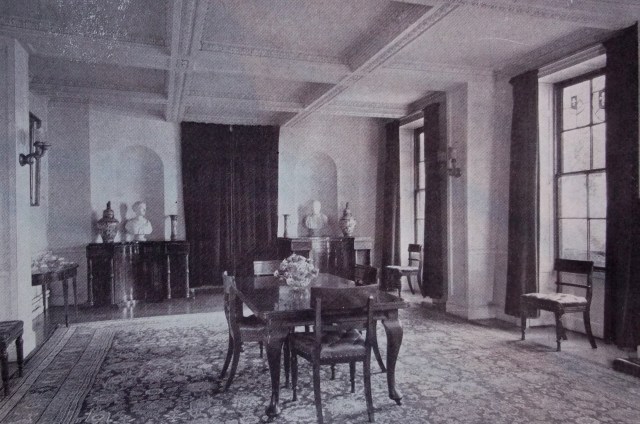
THE DINING-ROOM.  REGENCY DECORATION VICTORIAN FURNITURE

THE DINING-ROOM. REGENCY DECORATION VICTORIAN FURNITURE

On the the walls hang a number of portraits including those of Phineas Hussey, his second wife, Sophia Ray, and his brother, William, a surgeon in the Royal Horse Guards, who is said to have had a love affair with one of George III’s daughters. The last painting, which is in the manner of Hoppner and has been attributed to him, portrays the sitter against a pillar backed by a red curtain, one corner of which is folded up to reveal a distant view of St Paul’s Cathedral in a stormy sky. In his hands he holds an easily identifiable drawing of the Colosseum, across the bottom of which is written, “1803, Colosseo Hussey.”

The two brothers bear little resemblance to each other. William is handsome, tall and spare; Phineas short and corpulent. The latter is painted sitting at a table, with one arm resting on an open book, and he is staring sternly at the spectator. A mor human picture of him is given in Mrs. Charles Bagot’s memoirs, “Links with the Past” (1901), in which she recalls that “The squire (of Little Wyrley) was one of the last of the old sort of country squires. As a child, I dreaded his dining at Hatherton, and after dessert chasing me round the dining-room table to kiss my. I always thought then that he had dad too much wine, as had been the fashion of his youth.” In the same work Mrs Bagot quotes an extract from the diary of her aunt, recording (rather patronizingly) a visit to Little Wyrley in 1827. She describes the house as “a curious dwelling of red brick, gable ends, small windows, and heavy stone ornaments,” and her hosts “seemed to take me back a hundred years at least, as to civilization. Great cordiality and hospitality, a love of good cheer and field sports.” She goes on to express her surprise at “a fine collection of print which have been amassed at great expense by the master of the mansion.”

Phineas Hussey was twice married: first to Mary Fowler, who died when he was quite a young man and is commemorated in the garden at little Wyrley by an urn on a pedestal, and second to Sophia Ray, who bor him a son and heir in 1822, in which year he was high Sheriff of Staffordshire. It seems likely that the re-decoration of the house took place in preparation for his shrievalty. Among Mr Hussey’s friends was Anna Seward, the Swan of Lichfield, who enjoyed a considerable vogue as a poetess, although Horace Walpole associate her with Helen Williams and “a half a dozen more of those harmonious virgins” whose “thoughts and phrases are like their gowns old remnants cut and turned.” One of her rings, inscribed with her name, was given to Mr Hussey, presumably after her death in 1809, and is preserved at Little Wyrley with a number of other literary relics, such as a lock of Garrick’s hair surrounding a miniature of Shakespeare in a diamond locket.

Phineas Hussey seems to have been an extravagant man, and his estate was seriously embarrassed after his death in 1833 at the age of 71. Little Wyrley was for a time in Chancery and the house was let, but the heir, Phineas Fowke Hussey, was a minor when he inherited and the family finances had evidently improved by thetime he attained his majority. At all events, he returned to live at Little Wyrley, and turned his attention to cattle-breeding .
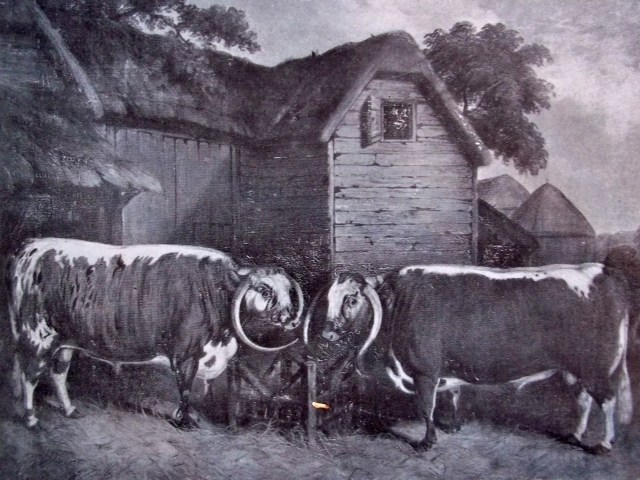
OLD ENGLISH CATTLE AT LITTLE WYRLEY: AN OIL PAINTING SIGNED BY E.M. FOX AND DATED 1855

OLD ENGLISH CATTLE AT LITTLE WYRLEY: AN OIL PAINTING SIGNED BY E.M. FOX AND DATED 1855

About 1850 he married Elizabeth Clementine Carmichael, who bor him two daughters before she died giving birth to a son in 1857. The son and mary, the elder daughter, died as infants and Little Wyrley devolved upon the younger daughter, Elizabeth, after her father’s death in 1867. She married Lachlan Andrew Macpherson, of Biallid, Inverness-shire, in 1885, and died in 1927. Owing to the untimely death of her two sons, the manor of Little Wyrley has now descended to her eldest daughter, Elizabeth, the wife of Mr Frank Wallace. His collection of big game heads is housed in the near-by barn, a fine timber-roofed building which was built by Ferrers Fowke and his wife Frances, whose triple F initials and the date 1664 are on a shield set in the north gable.
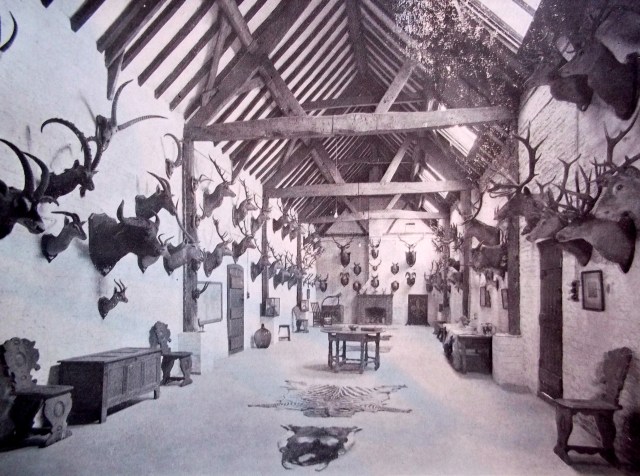
SPORTING TROPHIES IN THE BARN WHICH WAS BUILD IN 1664.  ITS DIMENSIONS ARE 70 BY 19 FEET.

SPORTING TROPHIES IN THE BARN WHICH WAS BUILD IN 1664. ITS DIMENSIONS ARE 70 BY 19 FEET.

It is a far cry from the Little Wyrley of the 17th century to the Little Wyrley of to-day, but Ferrers and Phineas Fowke would have no difficutley in recognizing the exterior of the house, and the interior must contain much that they would remember. Phineas Hussey, indeed, would be quite at home: his furniture is still in its place, his books on their shelves, his pictures and engravings on the walls. Changing times have nevertheless brought changes to Little Wyrley; for instance, Ferrers Fowke’s kitchen and brewhouse wing which in his and Phineas Hussey’s day would have teemed with servants, has now been converted into several flats. The most significant changes, however, have taken place in the house’s surroundings. According to Ekwall’s Dictionary of English Place-Names, Wyrley(pronounced Wirley) is derived from the Old English wir-leah, meaning “bog mytle glade,” but the impression created by this delightful name is dispelled even as early as 1801, when Shaw published his Staffordshire. The best that he can say about the neighbourhood of this “picturesque and curious specimen of the hospitable mansions of our forefathers’ is that the “situation can by no means be extolled wither for the beauty of its prospects, or excellence of soil.”

One wonders what Shaw woud say to-day, when the prospect westwards from the front door is terminated in the middle distance by a monumental slag-heap and when colliery workings have encroached to within a few hundred feet of the east side of the house. In the 1920s, indeed, it was proposed to mine underneath the house itself, but this threat has so far happily been unfulfilled and the old red-brick house still stands, witnessing to the old way of life amid its predatory surroundings.
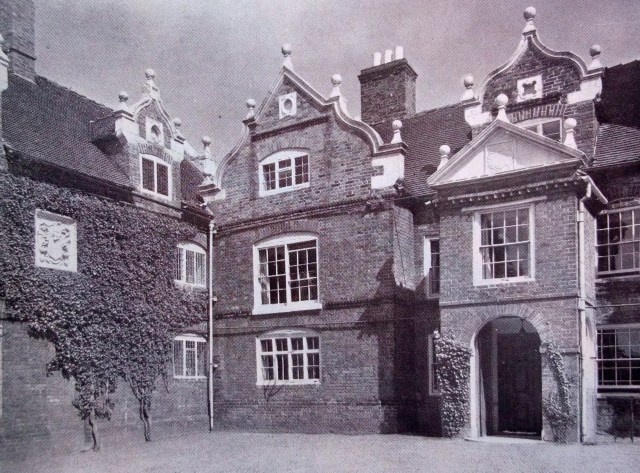
THE ENTRANCE FRONT WITH THE KITCHEN AND BREW-HOUSE WING ON THE LEFT
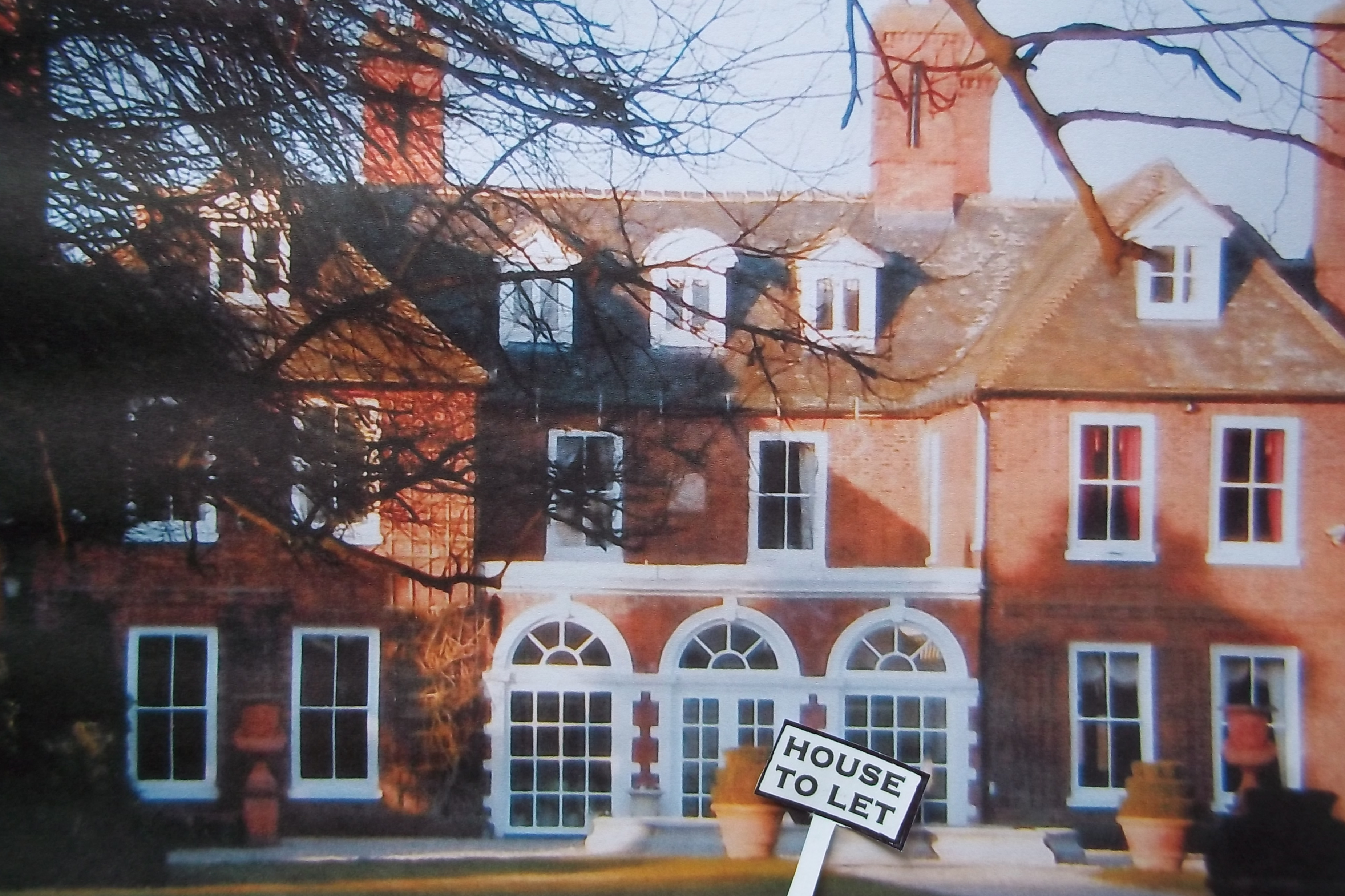
THE ENTRANCE FRONT WITH THE KITCHEN AND BREW-HOUSE WING ON THE LEFT

Posted in Uncategorized | 9 Comments

Faces in the Flames

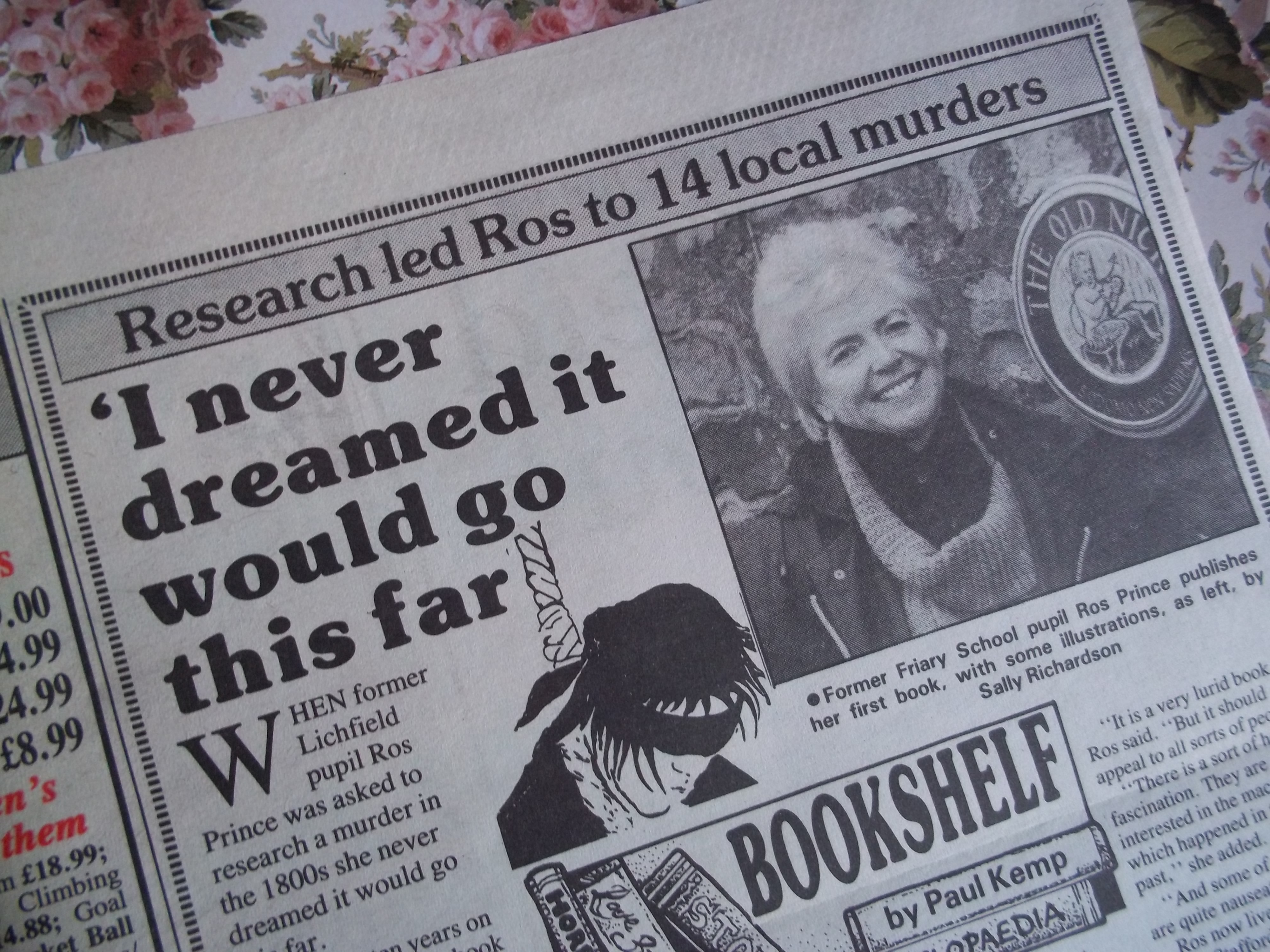
The Lichfield Mercury featured Ros and her books. At that time The Librarian of Cheadle and Blyth Bridge libraries, Ros has had several volumes published on the subjects of Staffordshire Crimes, Curiosities, and Castles.
It is a universal human tendency to see meaningful patterns in this life of cruel randomness. If we are lucky enough to spend a winter’s evening sitting in front of an open fire, we see faces in the flames.

Most people “believe” in meaningful co-incidence.

On rational reflection, it is no co-incidence at all that I should have happily lived my married life in a little old brick house with a big garden in the Staffordshire countryside that goes by the name of “Keeper’s Cottage”.  It was fortunate that at a timely moment, the widow of Mr Harrison’s last Gamekeeper had decided that the day had come when she would prefer the convenience of village life, and that the Trustees of the Wychnor Estate elected to auction off this small part of their property which thus became empty.  It seems almost inevitable when its photo appeared in Winterton’s advertisement that the sisterly resemblance of this cottage to pretty, if primitive, Keepers Cottage,  Footherly, where my Dad was brought up, would attract my parents’ attention, and lead to Ken and I buying it.

Less predictable was that when we told my cousin Rosalind that we would be living in this place called “Orgreave”, she said knew this very  spot most intimately, having just completed research here for her forthcoming book! Her reaction made a refreshing change, back in 1991, from having to inform someone – “No not that Orgreave,” and sigh, as conversation turned to heated political debate.

“Capital Crimes – Staffordshire Hanging Offences” included a chapter about a dramatic and dastardly double murder which took place only a score of yards from our front gate, just less than a century prior to our arrival in this small, sleepy, Staffordshire community.

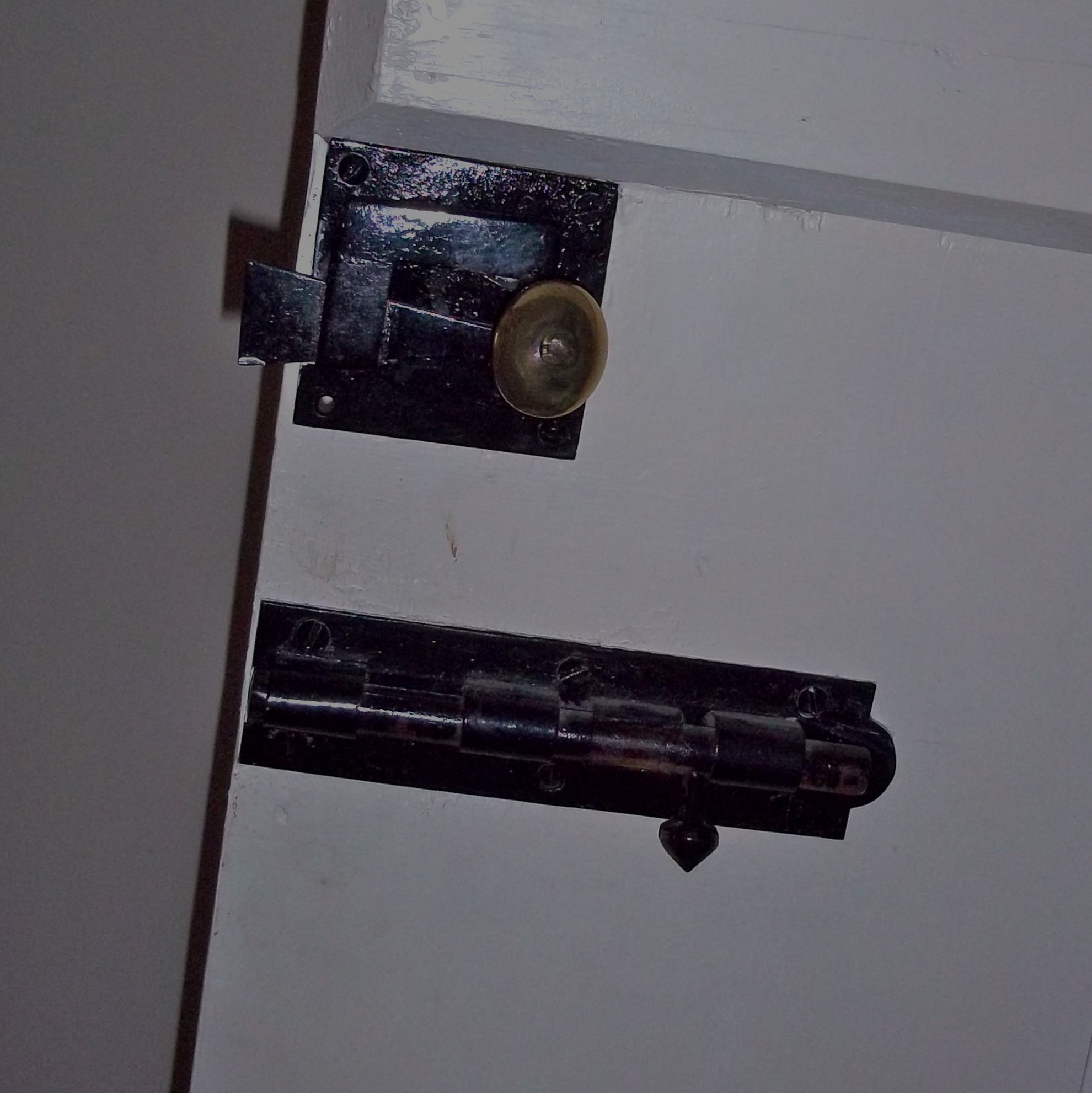
Reassuring security measures on our bedroom doors.

We had wondered why even the internal bedroom doors in our cottage sported such hefty Victorian bolts on their interiors – and the heavy planked oak back door can be additionally secured with a bar threaded through fastenings on either side of the jamb.

Now that we knew, we were interested and somewhat  excited – not emotions you would imagine that we would share with our predecessors in the area in the days following the fateful morning of 31st May 1895, but the reporter sent from the Tamworth Herald only the following week relates the news with a barely suppressed air of delight:

“On Friday morning last, in the tiny hamlet of Orgreave, in the Trent Valley, about a mile and a half from Alrewas, was committed, as reported in last week’s Herald one of those awful crimes which come once in a generation or two to thrill the whole of a quiet country side, and furnish a tale of horror for many years to come.”

In short, an armed man had approached a cottage in the hamlet at about 9 o’clock in the morning, and shot through the heart one George Hackett, who in one press account was washing himself outside the back door.  George’s stepfather, Mr. Frederick Bakewell was sitting at the table taking his breakfast, and was fatally shot through the back.  Mrs. Bakewell was shot at twice but survived.  As she undressed for bed that night, no doubt already in a terrible state of shock and grief, a bullet fell to the floor.  It had been embedded in her elaborate underclothing.  As Ros put it in her chapter’s title, Sarah Bakewell owed her life to a “Stay of Execution”.

“Capital Crimes”by Ros Prince (nee Cooper) includes a comprehensive, well researched report of the criminal career, capture, trial, and execution of Thomas Bond for the double murder at Orgreave in 1895.

Until June 14th, when the perpetrator, Thomas Bond was arrested, there was rumour, speculation, and abortive arrests were made.  Amongst other suspects were an unfortunate “imbecile”, and someone whose only crime proved to be that he was “a Frenchman”.  The Tamworth Herald reporter relished describing the atmosphere in the district during this fevered fortnight, which may have led to the speedy installation of the extra ironmongery on our doors:

“The tragedy has caused great excitement in Lichfield and Tamworth and in some of the villages near Alrewas, the inhabitants have been in a state of terror.  They have kept the doors of their houses locked and when anyone has knocked they have refused to answer it without having first satisfied themselves as the the character of the enquirer by going upstairs and looking out of the bedroom window.”

The cottage in question no longer stands, but is described in detail in contemporary newspaper reports, as every detail of the circumstances surrounding the murders was being pored over eagerly by readers:

“The kitchen in which the murders were committed is the only living room, and is a large and comfortable apartment.  It opens into a small grocer’s shop, to which entrance is gained by a door which abuts on the lane in front.  It is a picturesque cottage in a very pretty spot, and windows of the upper rooms jut out through the sloping thatch about.”

Mrs Bakewell had been born as Sarah Gaunt in the nearby village of Hammerwich.  She married John Hackett of Orgreave in 1857, becoming a member of a family which had remained numerous in the immediate area for many decades. John and Sarah had a family of six children, and when he died in 1878, she stayed on in the family cottage, making a living by running a grocery business from the premises.  Meanwhile, Frederick Bakewell, an Orgreave man by birth, had lived in Norton Road, Pelsall, and worked as a plate-layer. His wife Sarah Dolman, from an established Alrewas family, had died in 1873 after bearing him at five children.  We presume that Frederick renewed connections with his birthplace in middle age, and married and moved in to the Orgreave cottage with the widow Sarah Hackett in his 56th year.

The cottage, its neighbours, and even a little chapel are remembered as ruins of their former selves in the 1930s by the oldest residents of present day Orgreave.   Around the Wychnor Estate, pairs of boxy 1960’s semi-detached dwellings for “tied hands”, welcomed enthusiastically in their day for their indoor plumbing and electric light, have been erected on the sites of tumbledown thatched cottages. Other accommodation, like the Bakewell/Hackett cottage, was not replaced because it was no longer required.  Like many rural villages, Orgreave’s population has vastly reduced over the last hundred years or so, as fewer and fewer man-hours are required to farm a given acreage. Nothing now is left of the “picturesque cottage” which saw so much blood pooling gruesomely on its kitchen floor, other than concentrations of broken masonry thrown up in certain patches each year by ploughing.  The site is a small unkempt field lying in front of  Orgreave Farm.

View across the site of the Bakewell/Hackett cottage in Orgreave to the upper windows of Orgreave Farmhouse, from which Mrs Barton watched Thomas Bond commit murder.

At the time of the murders in 1895, what is now known as Orgreave Farmhouse was inhabited by a Mr. Morris Piddocke Averill, noted in press reports to be a guardian of the Lichfield Union.  On the day of the murder, Mr Averill’s mother-in-law, Mrs Barton, watched the horrible drama unfold from the upstairs window of the house.  “Mr. Averill’s residence and grounds,” the Tamworth Herald explains, “are separated from Bakewell’s by the village roadway and a fine view is obtained of the country to the south and over Bakewell’s cottage.”  The view of events from what is now my own bedroom window would have been only slightly more obscure.

Frederick Bakewell and George Hackett were buried, side by side, in the graveyard of All Saints Church, Alrewas.

What is described in reports as the “village roadway” dividing Orgreave Farm from the cottage is in fact a very ancient track down which goods have passed for thousands of years.  On foot (or in dryer times, bicycle), it can still be followed all the way to Alrewas, and may have been the route down which some of the “large and sympathetic crowd” reached the funeral and burial of Frederick Bakewell and George Hackett at Alrewas Parish Church. “The proceedings,” we are told, “were very solemn and impressive”.  and that “The mourners consisted of relatives from Chesterfield, Donisthorpe, Pelsall, Bloxwich, Walsall, Kings Bromley and elsewhere”

On August 20th, Tommy Bond’s corpse was subject to a contrastingly ignominious interment within the precincts of  Stafford Gaol, following his trial, conviction and execution by hanging.

Posted in Uncategorized | 8 Comments

The Long and the Short of it.

20121119-234056.jpg

Bold, beautiful and flame-haired. A young Mary Horton sports the “Eton Crop” in 1920’s Walsall Wood.

No corsets! Bare legs! Short hair! It’s hard to realise from the distance of nine decades just how radical the young women of the post Great War period seemed to their contemporaries when they refused, in a simultaneous and victorious revolution, the constraining sartorial conventions of their elders. Short hair for females may have existed in earlier eras, but only beneath wigs and hairpieces. Luxuriant tresses, like the wearing of skirts had always been a reliable signal of femininity in England (The Celtic Fringe – pardon the pun – having maintained a slightly variant tradition.) Suddenly, in the middle of the 1920’s, hemlines soared, waistlines dropped, and the most extreme of the new “bobbed” hairstyles, called the “Eton Crop” was in vogue. Fashion was newly democratic: the modern, simply styled, shift dresses could easily be “run up” at home or by a local dressmaker, as opposed to the elaborate, long and full, couture gowns of two decades before. Back then, it had been only mature, wealthy women who could flaunt their ability to keep up with the trends. Now, a gaggle of lively young teenaged girls in a small South Staffordshire mining community could be as “up to the minute” as everyone else – much to the consternation of their families:

Easter time Cousin Sis ( fair haired), Louie (black) me (red) all went to the barbers at Walsall Wood to have the very latest Ladies Haircut.. the “Eton Crop”! When we came out, snow was falling and our heads were bare. When we got to Sis’s we waited a few seconds, but Aunt Alice didn’t shout. Got down to Louie’s – she was expecting a row – I went in to No. 1 confident I could handle the situation. I think my Dad said something like ” Weer’s your trousers ?” Mam said, ” What a bloody mess. “

Louie – Louisa – Beardsmore, was my Aunt Mary’s neighbour, schoolfriend, and confidante. It was to Louie she turned for some advice about dealing with the opposite sex now she had reached her teens. Mary wrote about receiving this stern warning from Louie:

I must not let lads kiss me or kiss them back ; I must never put my hand in their trouser pocket ; I must never let them put their hand in my coat pocket; all or either of these things could result in a baby


Louie Beardsmore was a couple of years older than her friend Mary. Louie had been born in 1910, which enables me to scrutinise her family situation, detailed on the 1911 census. It makes interesting reading, and it sheds some light on her extreme caution in avoiding, at all costs, the risk of untimely procreation!  The Beardsmore household shared a dwelling comprising just four habitable rooms in a house on Aldridge Road, Vigo. It totalled four adults and eight children. Louie’s father, Joseph, and his wife, had come to Walsall Wood from Gornal in the heart of the Black Country, and had, so far, six children. The Beardsmores also harboured four “boarders” in the little house, also migrants from Lower Gornal. Isaiah Hughes was a miner like Joseph, and also living in this intimate proximity was “Miss” Teresa Hale, who was Mrs Beardsmore’s sister. Teresa earned her living as a dressmaker, and squeezed in with her, somehow, were her two young and, presumably illegitimate,sons, Reuben and George. It isn’t easy to visualise how these few rooms, even subdivided and screened off with curtains, could provide any privacy, or even sufficient floor space for the occupants to sleep comfortably. However, their situation was by no means unique in the area.

I see from later records that Isaiah Hughes and Teresa Hale married each other in 1913, which I hope was a happy outcome for them.

The “Eton Crop” was named for its similarity to the the style adopted by the schoolboys of Eton College, who deliberately wore their hair a little longer than normal male convention dictated. The height of its popularity with women was relatively short-lived, and by 1929, their hair was already being styled in slightly longer, wavier, bobs…. with the honourable exception of the occasional monocled Sapphist.

My Aunt Mary’s beautiful, copper coloured locks grew back again.

There is something universally seductive about a full, long, feminine head of hair. As a child, Aunty Mary had been prepared to risk angering her mother to admire at close quarters the “crowning glory” of her neighbour, Mrs Muschin.

There were people in the street we were not allowed to speak to. One lady, Aggie (Agnes) Muschin’s Mum used to let me in through her back door and say ” Does your Mam know ?” I would whisper “No”. I would play with Aggie, then we would brush and comb Mrs. Muschin’s hair. When she sat on a chair and undid the plaits, it hung down to the floor, it was like a coal black wavy shawl, we could plait it; roll it round her head; tie it up on top of her hair in a big bun…. She would say ” Better go home before your mother misses you.”

Where did the Muschins come from? The name is absent from the census returns in Staffordshire. There was to be a woeful end for Mrs Muschin.

Mrs Muschin became ill, I gather doctors had said she was not to have any more children, Muschin had been warned a baby would kill her. When the ambulance came for her I rushed up our stairs and looked down on her being loaded onto the ambulance. Never saw her again, or Aggie. The children went during the night.

I can imagine Louie Beardsmore shaking her head sadly, and taking note.

Posted in Uncategorized | Leave a comment